
PDF · US Letter · 24 KB · Free, no sign-up. For home and classroom use.
Jungle coloring page
Two palm trees, a looping vine, a bank of big notched leaves and a toucan on a branch, free as a US Letter PDF.
This is a scene rather than a single subject. Two palm trees stand across the top of the sheet, each with a plain straight trunk and a crown of long fronds. A vine hangs between them, drawn as a double line that dips into a deep loop in the middle and trails downward. Across the bottom third, big banana leaves rise from the edge of the paper and overlap one another. On the right a toucan perches on a branch with a leaf spray on either side of it. There is no sky, no ground line and no background, so every shape sits directly on white paper.
The palm fronds are the shapes that set the character of the drawing. Each one is a closed outline with deep notches torn out along both edges, so a frond is not a feathery thing made of separate leaflets but a single broad blade with a ragged margin. That makes them fast to fill and it makes an alternating scheme easy: coloring every other frond a slightly deeper green separates the crowns, which otherwise run together where the two trees meet in the middle of the page.
The bank of leaves along the bottom is the densest part of the sheet, and it works on overlap. Each leaf is a closed shape with a doubled line running down its middle for the midrib and the same torn notches along its edges, and each one hides part of the leaf behind it. Because the leaves overlap, the order they are colored in matters: doing the frontmost first and working backward means every later leaf is bounded on one side by a finished edge, and nothing has to be steered around.
The toucan is the one thing on the page with a face, and the beak is more than half of it. It is drawn as a long curve with a separate band across the tip and a narrow band where it meets the head, which gives three areas rather than one — and a real toucan's bill carries bands of color in roughly that arrangement, so following the outline gives a plausible bird with no reference needed. Behind the beak, one round eye with a filled pupil sits inside a rounded patch, and that patch is a separate closed shape that takes a color of its own.
The bird's body is built from a few large pieces: a rounded chest, a big wing outlined over it with two feather lines at its trailing edge, and three long tail feathers hanging below the branch. Two feet grip the branch and are drawn as bands wrapped around it. The wing is the piece worth treating carefully, because it is drawn on top of the body rather than beside it, and a wing in the same tone as the chest disappears into it. One step darker on the wing is enough to hold the two apart.
The vine is the only line on the sheet that crosses in front of something else. It passes over the fronds of both palms, dips low between them and hangs down past the leaves. Because it is drawn as two lines rather than one, it is a long narrow closed shape and can be filled — and it is worth filling in something that contrasts with the greens around it, since it is the single element tying the left half of the page to the right.
Colors here are wide open. A jungle sheet colored in greens is the expected reading, and green in four or five values across the fronds, the leaves and the vine gives a page that hangs together with no other decision to make. The toucan is the place to break that, since a real toucan's bill and chest carry bright color against a dark body, and one saturated shape against a page of greens is what stops the drawing reading as wallpaper. A sheet done entirely in blues and purples is equally correct; nothing in the outline argues for anything.
Print at actual size on plain letter paper rather than fit-to-page, so the notches in the fronds and leaves keep their depth; scaled down they start to close up and the ragged edges read as straight ones. Card stock is worth using if markers are coming, because the leaf areas are large and adjacent and the ink has a lot of edges to sit against. This is a picture rather than a set of objects, so it does not cut apart usefully; it suits a wall or a folder cover whole, and the empty white above the palm crowns is room for a sky if anyone wants to add one.
Before you print
- Alternate two greens across the palm fronds so the two crowns do not run together where they meet.
- Color the frontmost leaf first and work backward; every later leaf is then bounded by a finished edge.
- Give the toucan's beak three separate treatments — tip band, main curve, base band — and follow the outline.
- Put the wing one step darker than the chest, or it disappears into the body it is drawn over.
- Fill the vine in something that is not green; it is the one shape joining the left of the page to the right.
Published Updated 784 words
More in this section
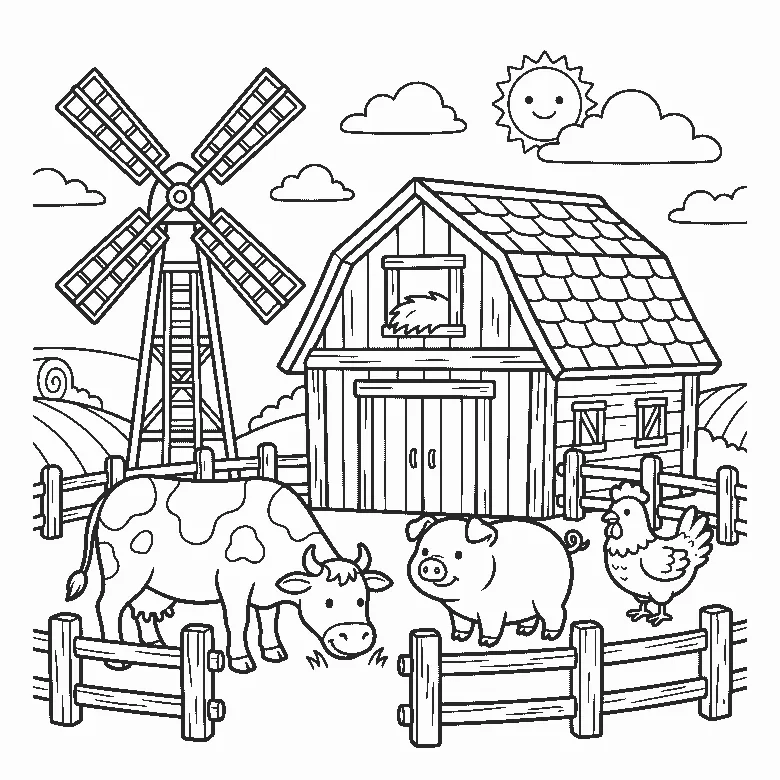
Farm coloring page
A barn, a windmill, three animals and a smiling sun in one full-page farmyard scene.
Coloring outline drawn by us.
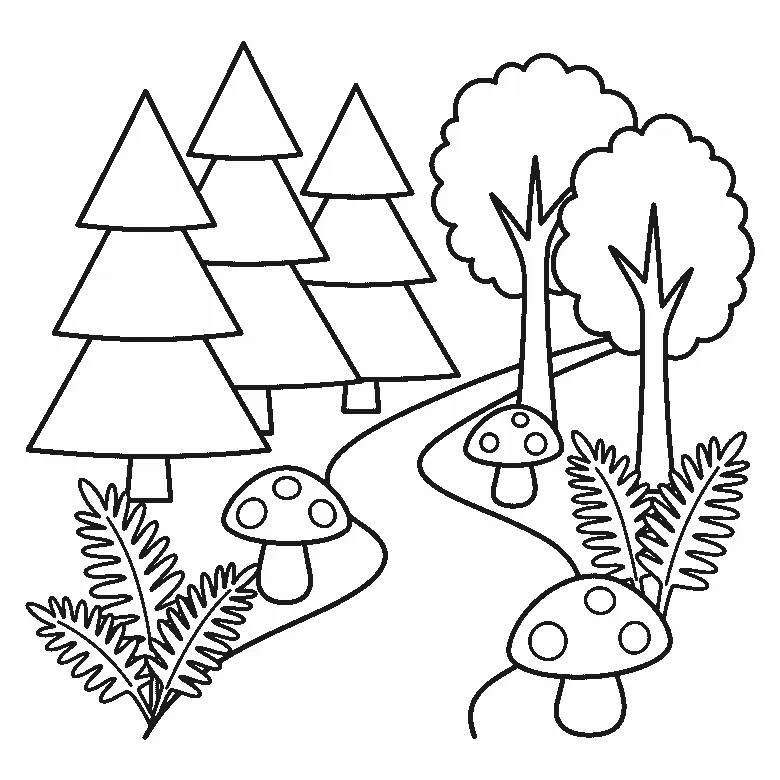
Forest coloring page
Three firs, two round-crowned trees, a winding path, three spotted mushrooms and two ferns.
Coloring outline drawn by us.
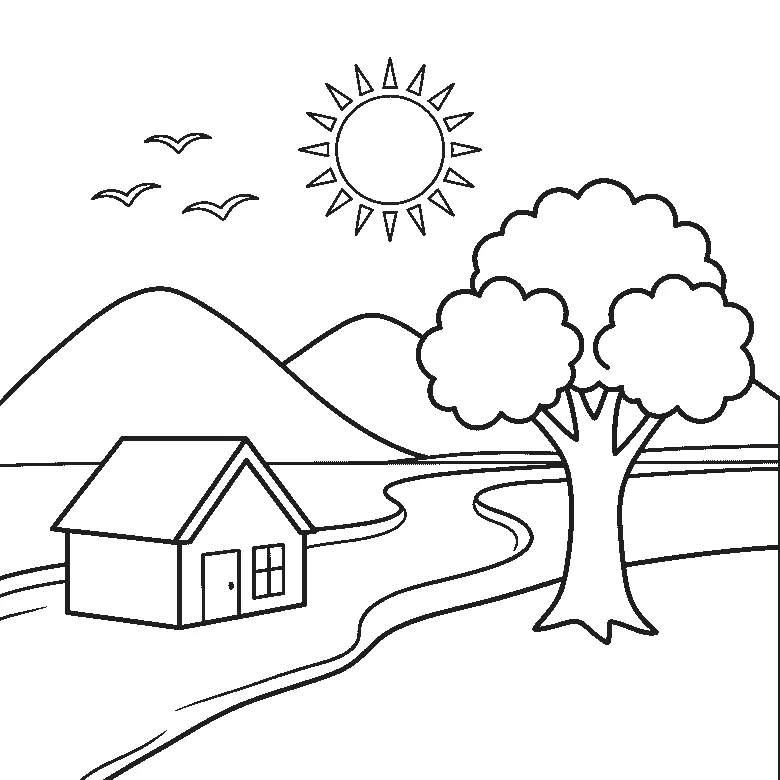
Landscape coloring page
Hills, a winding river, a broad tree, a small house and a plain faceless sun in one open scene.
Coloring outline drawn by us.
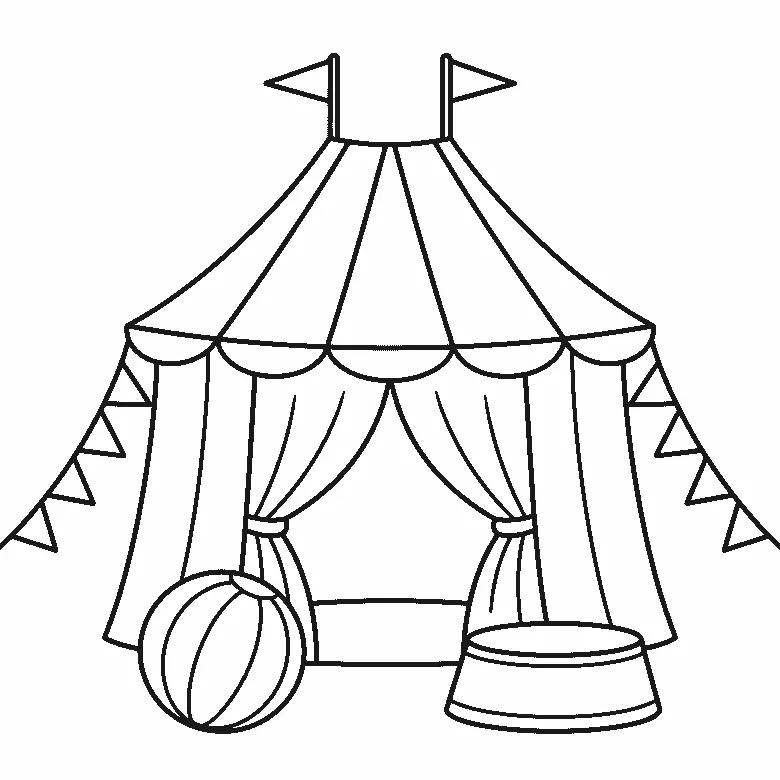
Circus coloring page
A big top tent with a six-panel roof, curtains tied back, bunting, a striped ball and a podium.
Coloring outline drawn by us.
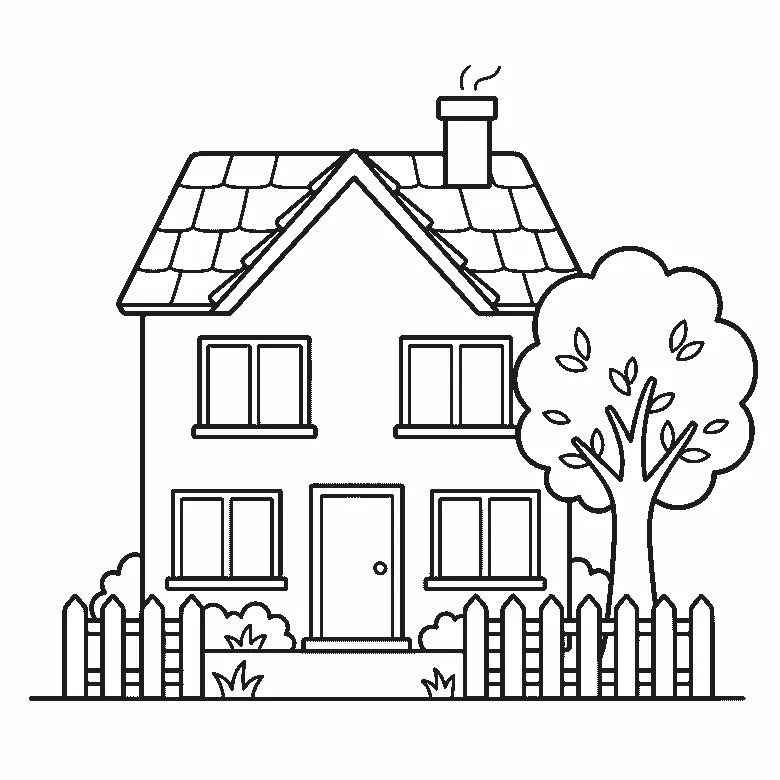
House coloring page
A two-story house seen straight on, with a tiled roof, a smoking chimney, a picket fence and a tree at the side, free as a US Letter PDF.
Coloring outline drawn by us.


