
PDF · US Letter · 21 KB · Free, no sign-up. For home and classroom use.
Forest coloring page
Three firs, two round-crowned trees, a winding path, three spotted mushrooms and two ferns.
A path winds up the page from the bottom, curving between the trees and narrowing as it goes back. To the left of it stand three fir trees, each drawn as a stack of three broad triangles on a short trunk, overlapping so the nearest is largest. To the right stand two round-crowned trees with bumpy cloud-like outlines and forked trunks. Three mushrooms with wide round caps sit along the path, each cap carrying three round spots. Two ferns fill the lower corners, drawn as clusters of fronds with finely toothed edges. There is no sky, no ground line and no horizon — the drawing sits on white paper.
The path is the organizing shape and the first thing to decide about. It is one continuous lane that runs from the bottom edge to the middle distance, and coloring it — even a pale sand or gray — separates the left half of the drawing from the right half and gives the whole scene a direction. Left white it still works, but the two groups of trees then read as two unrelated clusters.
The three firs are stacked triangles, nine broad closed shapes in total, and they are the largest fillable areas on the sheet. Because each tree is three tiers, a graded set works beautifully: darkest at the bottom tier, lightest at the top, repeated on all three trees. That takes one pencil and gives the little wood some depth without a second color.
The two round-crowned trees are drawn as single bumpy outlines rather than as separate clumps of leaves, so each crown is one enormous area. That makes them the fastest shapes here and the flattest. Adding a few short curved strokes inside the crown, following its bumps, breaks up the flatness in a way the drawing has deliberately left room for.
The three mushrooms are the detail, and they are the reason to keep a sharp pencil at hand. Each has a wide cap with three round spots and a short stem, and the spots are small enough that filling around them with a broad tip will swallow them. Leaving the spots white against a colored cap is both faster and more legible than the other way round.
The two ferns are the finest work on the sheet. Their fronds are drawn with a jagged saw-toothed outline running down each side, and no broad tool can follow that. They can be filled roughly, which turns them into green blobs, or left white with only the central rib colored, which keeps every tooth visible. On a page this open, the second choice is the one that keeps the corners interesting.
One plain fact about the trees is drawn into their shapes. A fir keeps its needles all year and its branches sweep down and out in tiers, which is why it is drawn as stacked triangles; a broadleaf tree spreads its crown into a rounded mass and drops its leaves, which is why the other two are drawn as bumpy clouds on a forked trunk. The two silhouettes are the quickest way to tell the two kinds apart at a distance, and the drawing puts them side by side.
Print at actual size on plain letter paper so the fern teeth and the mushroom spots keep their edges. Regular copier paper takes pencil and crayon fine. If markers are the plan, the fir tiers and the two crowns are large flat fields where bleed shows, so slip a scrap sheet underneath. This sheet is a picture rather than a set of objects and does not cut apart usefully, but it pins to a wall well because there is no background to compete with the trees.
Before you print
- Color the path even faintly; it gives the scene a direction and joins the two groups of trees.
- Grade the three tiers of each fir from dark at the bottom to light at the top, using one pencil.
- Add a few short curved strokes inside the round crowns, following their bumps, to break up the flatness.
- Leave the three spots on each mushroom cap white and color around them.
- Leave the ferns white with only their central ribs colored, so every tooth on the fronds stays visible.
Published Updated 618 words
More in this section
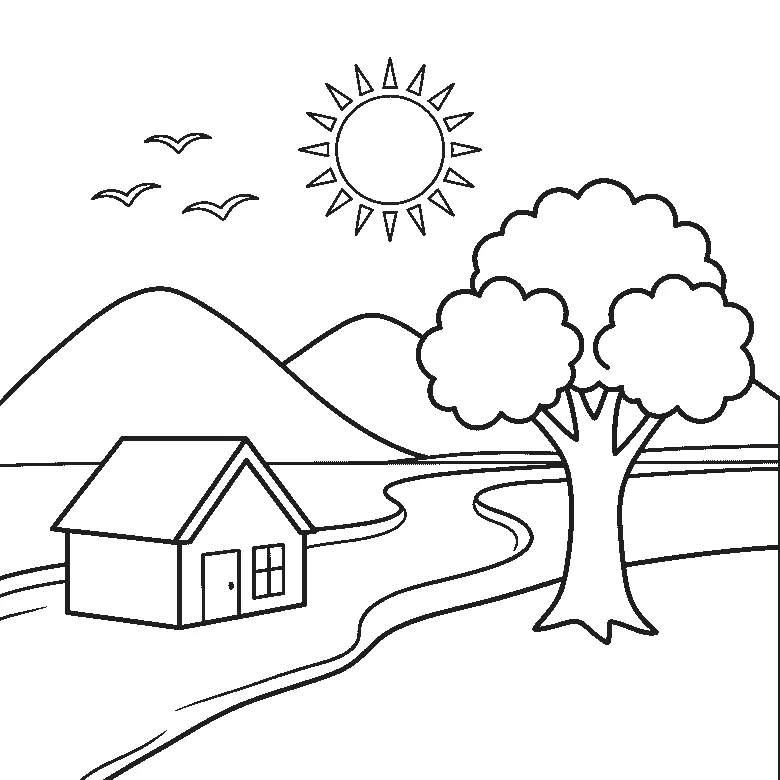
Landscape coloring page
Hills, a winding river, a broad tree, a small house and a plain faceless sun in one open scene.
Coloring outline drawn by us.
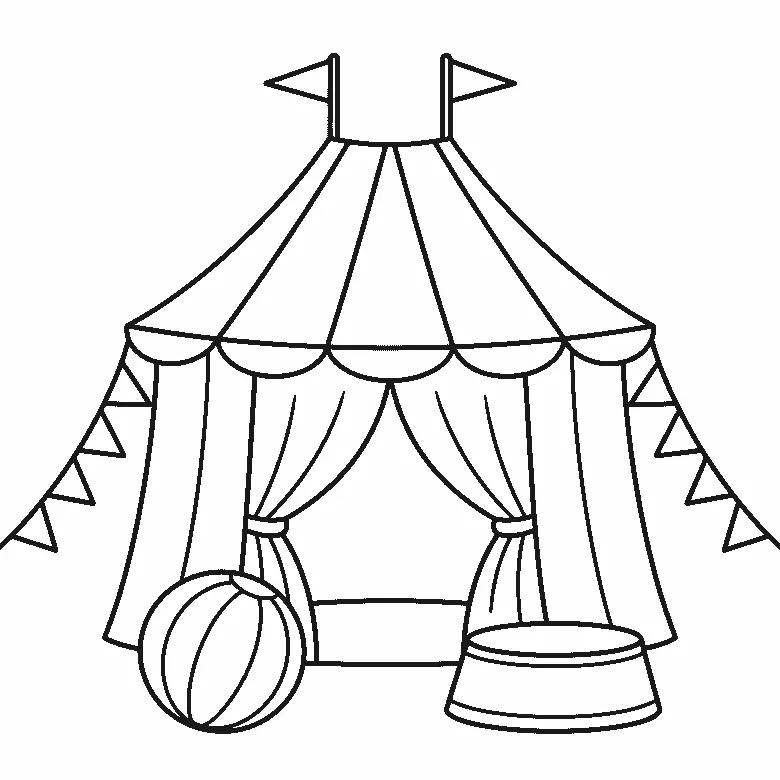
Circus coloring page
A big top tent with a six-panel roof, curtains tied back, bunting, a striped ball and a podium.
Coloring outline drawn by us.
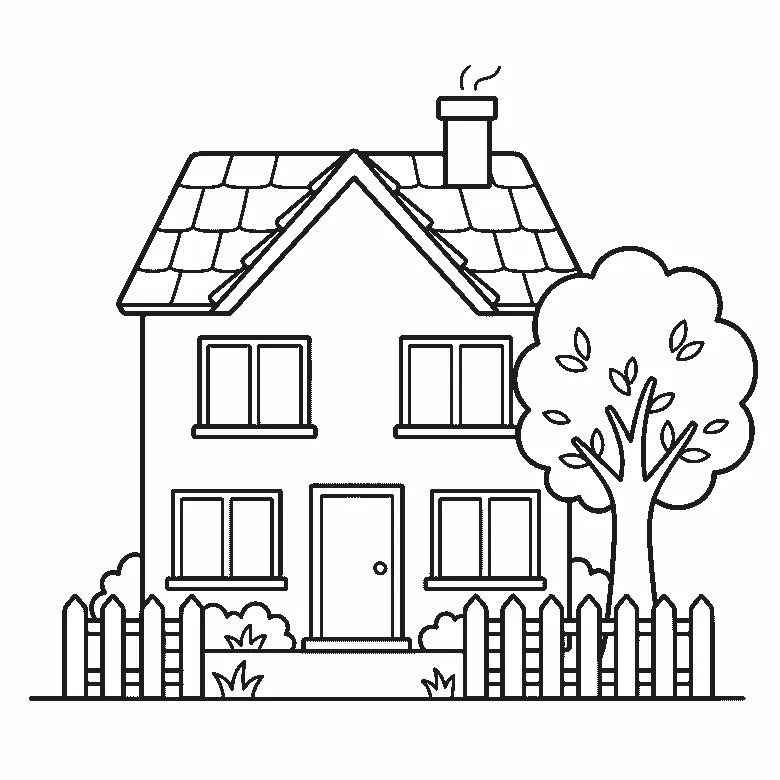
House coloring page
A two-story house seen straight on, with a tiled roof, a smoking chimney, a picket fence and a tree at the side, free as a US Letter PDF.
Coloring outline drawn by us.
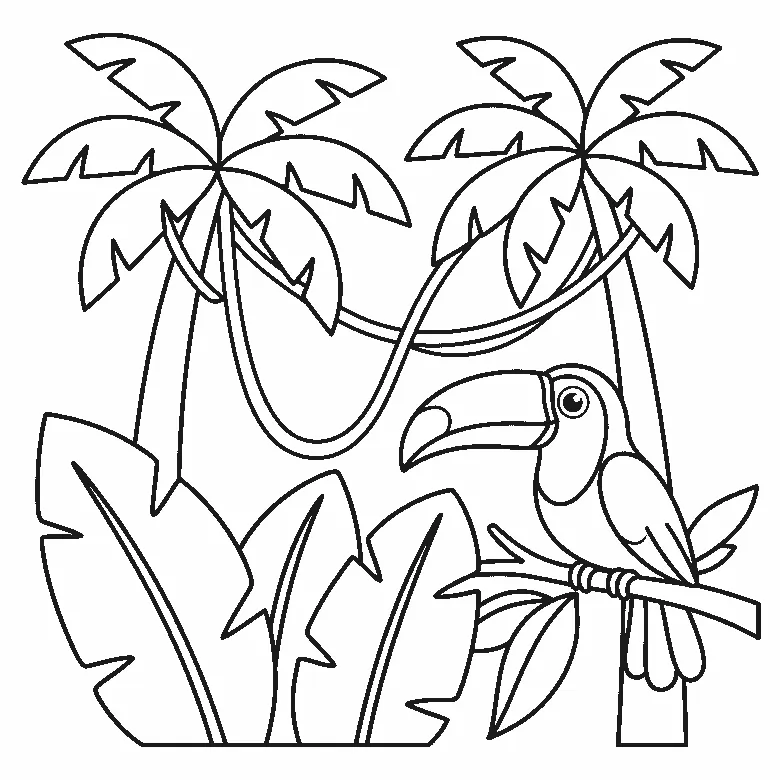
Jungle coloring page
Two palm trees, a looping vine, a bank of big notched leaves and a toucan on a branch, free as a US Letter PDF.
Coloring outline drawn by us.
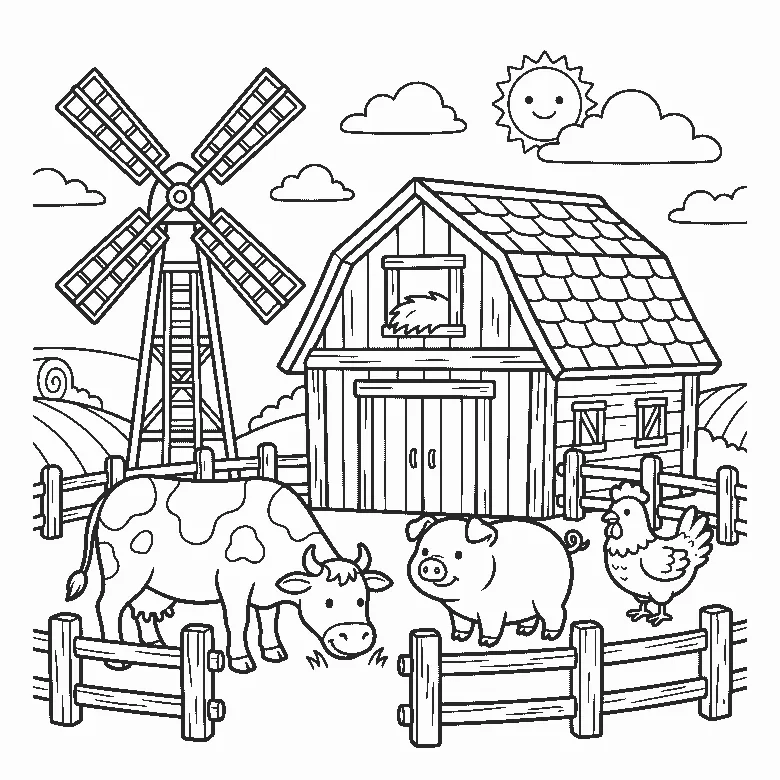
Farm coloring page
A barn, a windmill, three animals and a smiling sun in one full-page farmyard scene.
Coloring outline drawn by us.


