
PDF · US Letter · 12 KB · Free, no sign-up. For home and classroom use.
House coloring page
A two-story house seen straight on, with a tiled roof, a smoking chimney, a picket fence and a tree at the side, free as a US Letter PDF.
The house on this sheet is drawn flat on, with no perspective at all, so every wall, window and door is a plain rectangle and nothing is foreshortened. A pitched roof sits over a two-story front. Four windows are set in two rows of two, each divided down the middle into a pair of tall panes and each standing on a sill. Between the lower pair is a front door with a small round handle and a step under it. A chimney rises from the right-hand slope of the roof with two curls of smoke above it, and a picket fence runs the full width of the page in front of the garden.
The roof is where the drawing puts its patience. It is not a plain triangle: the tiles are drawn as overlapping scalloped rows running from the ridge down to the eaves, and there are a great many of them. Coloring every tile individually is one way to spend a long afternoon. Laying one color across the whole roof and then going back to darken only the bottom edge of each row is much faster and gives almost the same effect, because what the eye reads as a tiled roof is the row of curved shadows and not the tiles themselves.
The windows are the easiest decision on the page and the one that changes it most. Left white they read as glass with light behind them. Filled pale blue or gray they read as glass reflecting the sky. Filled a warm yellow they read as rooms with the lights on, and the same house immediately looks like evening rather than midday. Whichever way they go, all four want to agree with one another; one lit window among three dark ones is a deliberate effect and worth doing only if it is meant.
The tree at the right is drawn the way a young child draws a tree and the way almost no real tree looks, which is why it works. Its canopy is one large closed outline made of bumps, and inside that outline the branches are drawn as bare forked lines with small pointed leaves budding off them. So the canopy is not full of leaves; it is an empty shape with a few leaves in it. That gives two separate things to color — the ground of the canopy and the leaves sitting on it — and using two greens rather than one is what stops the tree reading as a flat blob.
The fence runs edge to edge and is built from pointed pickets crossed by two horizontal rails. Every picket is the same shape and the same width, which makes an alternating scheme very easy to lay down and very hard to correct once it has started. Counting the pickets before the first stroke is worth the minute it takes if two colors are going to alternate, because an odd number means the pattern meets itself at one end. A single color across the whole fence, with the rails behind it left a shade darker, avoids the problem entirely.
Bushes sit along the base of the wall on both sides and two small tufts of grass grow through the fence, drawn as short spiky clumps. These are the shapes to use for variety, since they are small, there are several of them, and nothing depends on them matching. The ground line runs the full width beneath everything. Above the roof the paper is completely empty, so anything that goes there — a sky, a sun, birds, nothing at all — is a decision the drawing leaves entirely open.
There is one piece of drawing craft on this sheet worth noticing while you work. The house is symmetrical about the front door, and the two things that break that symmetry are the chimney, which stands on the right slope, and the tree, which grows on the right side. Without those two the picture would be a mirror image of itself and would look like a diagram. Coloring the tree and the chimney in tones that stand out from the wall keeps that imbalance visible, and the house stays a picture rather than a plan.
Print at actual size on plain letter paper so the roof tiles and the fence rails keep their spacing; fit-to-page closes the gap between rows and the tiles start to merge. Card stock is worth using if markers are planned, because the roof and the walls are large flat areas that soak up ink. Cut along the outline of the house alone and it stands up against a fold of card as a model front; left whole, the sheet works pinned up, since the fence and the ground line give it a bottom edge that already looks finished.
Before you print
- Lay one color over the whole roof, then darken only the lower edge of each tile row — it reads as tiles for a fraction of the work.
- Decide what the four windows are doing before you start: white glass, sky reflection, or lit rooms.
- Use two greens on the tree, one for the canopy ground and one for the small leaves drawn on top of it.
- Count the fence pickets before alternating two colors, or the pattern will meet itself at one end.
- Save the bushes and the grass tufts for variety; they are small, plural, and nothing has to match.
Published Updated 798 words
More in this section

Jungle coloring page
Two palm trees, a looping vine, a bank of big notched leaves and a toucan on a branch, free as a US Letter PDF.
Coloring outline drawn by us.
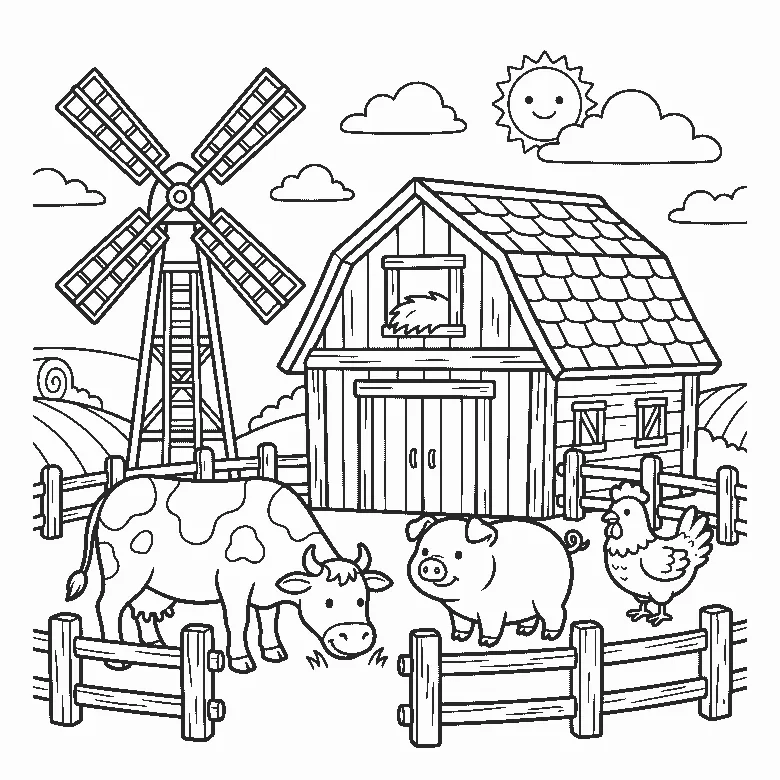
Farm coloring page
A barn, a windmill, three animals and a smiling sun in one full-page farmyard scene.
Coloring outline drawn by us.
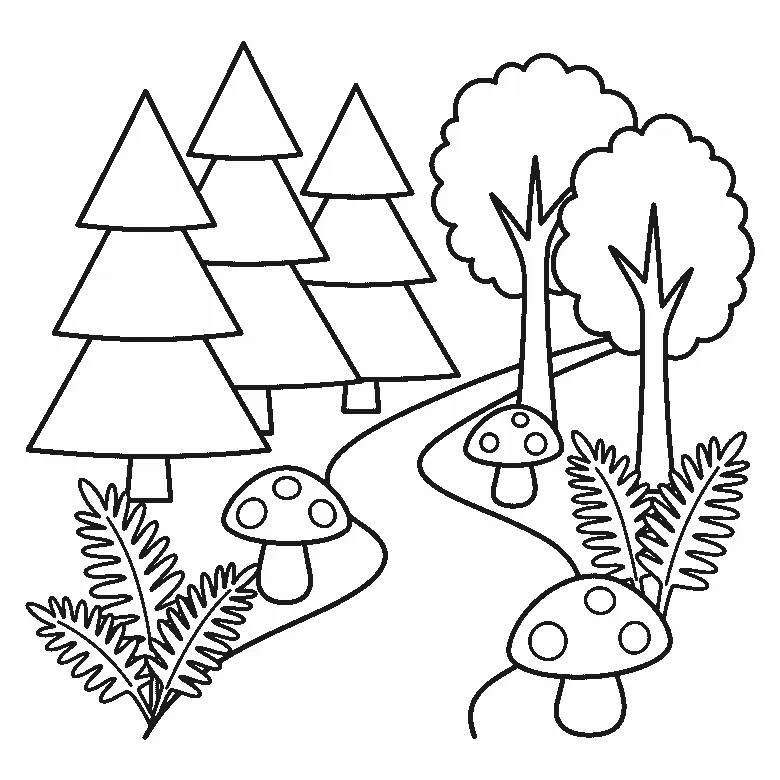
Forest coloring page
Three firs, two round-crowned trees, a winding path, three spotted mushrooms and two ferns.
Coloring outline drawn by us.
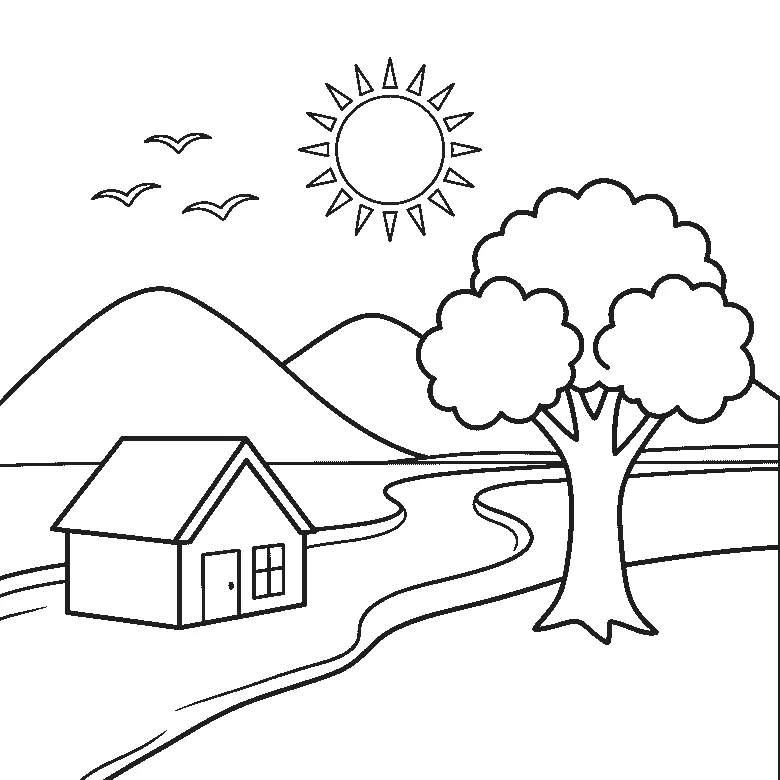
Landscape coloring page
Hills, a winding river, a broad tree, a small house and a plain faceless sun in one open scene.
Coloring outline drawn by us.
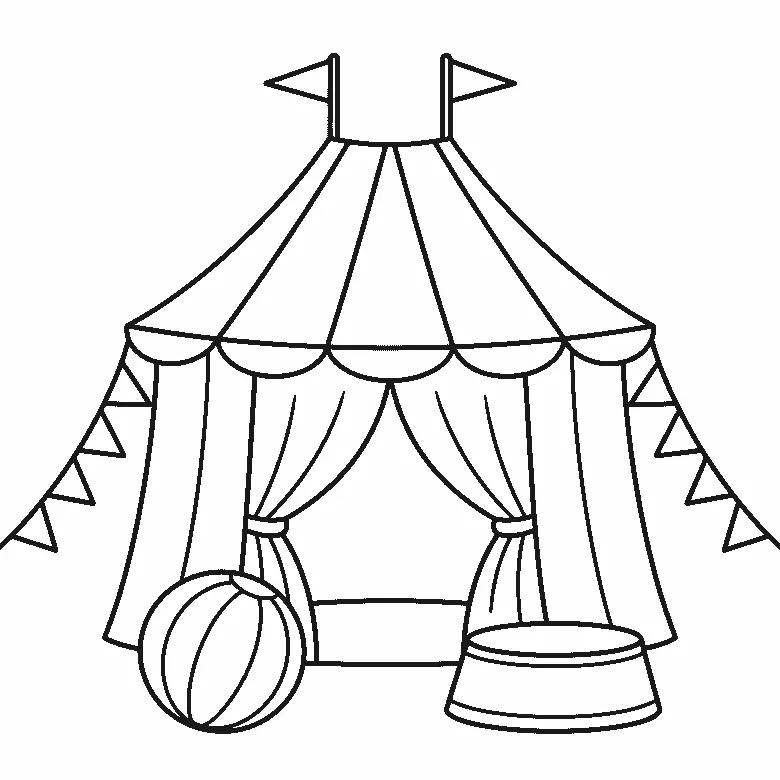
Circus coloring page
A big top tent with a six-panel roof, curtains tied back, bunting, a striped ball and a podium.
Coloring outline drawn by us.


