Mandalas
Printable mandalas, from a ring of hearts to a dense geometric grid, every one of them radial and symmetrical.
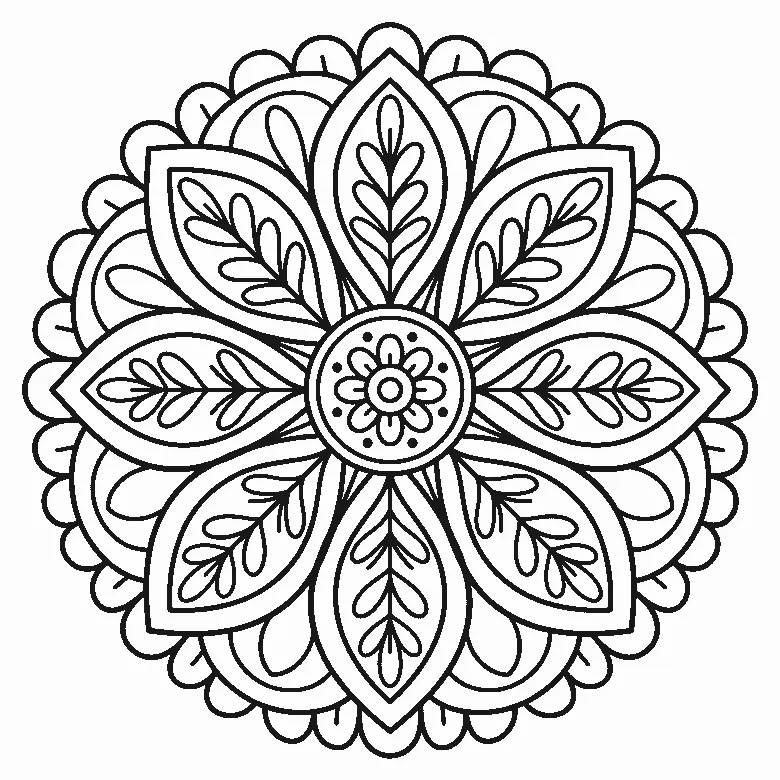
Flower mandala coloring page
Eight petals of leaf sprigs around a ringed center, held inside a scalloped border for slow, quiet coloring.
Coloring outline drawn by us.
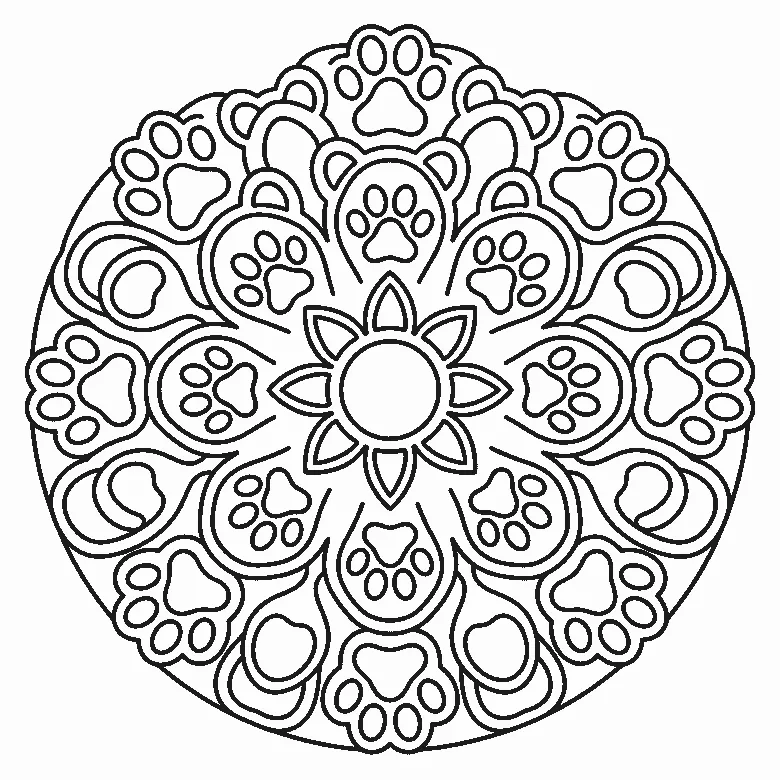
Animal mandala coloring page
A circular mandala of paw prints and rounded ear shapes around an eight-petal flower, free as a letter-size PDF.
Coloring outline drawn by us.
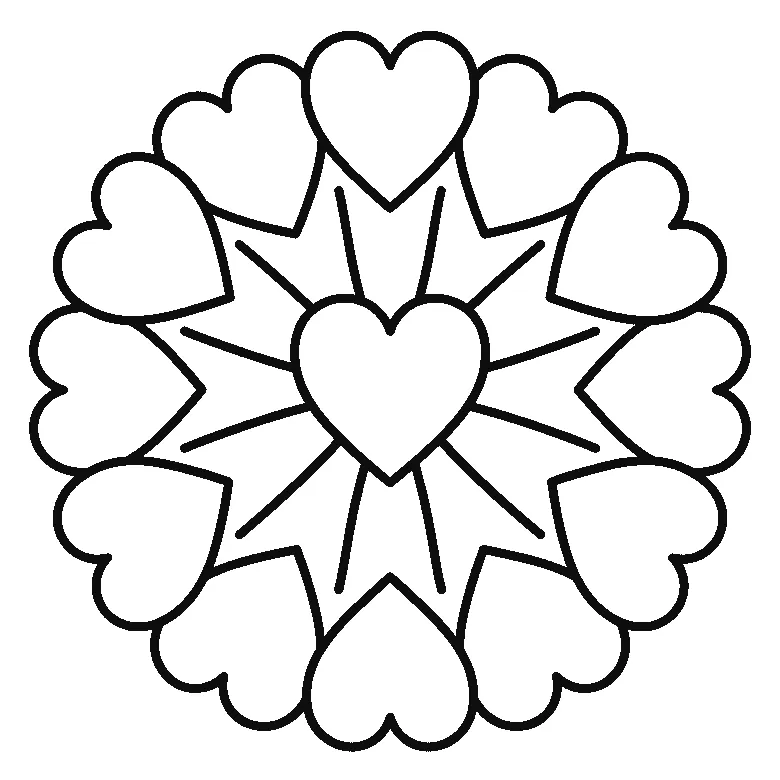
Heart mandala coloring page
One heart on a starburst at the center, ringed by two rows of larger hearts pointing inward. Free letter-size PDF.
Coloring outline drawn by us.
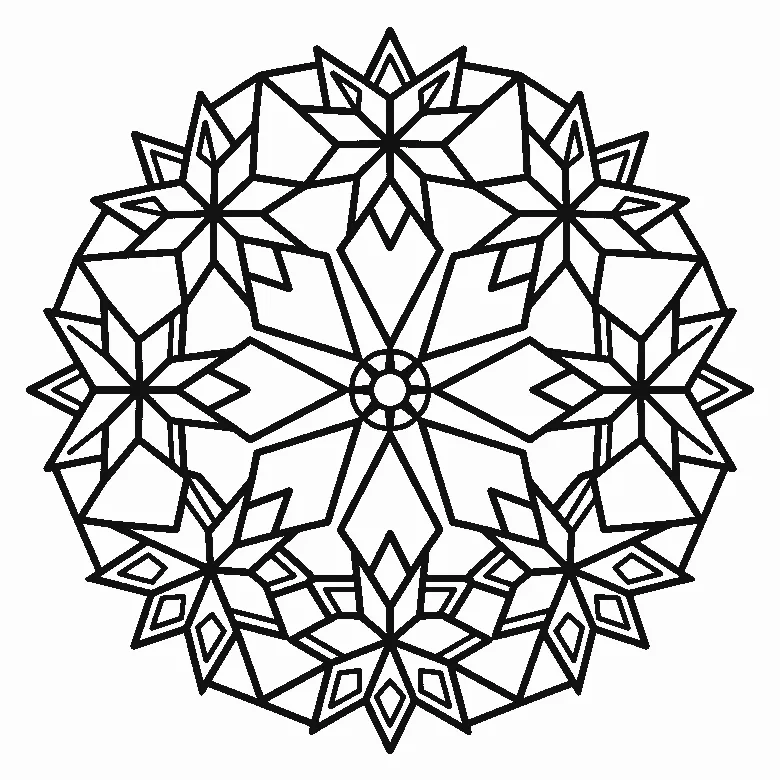
Star mandala coloring page
Eight-pointed stars and faceted diamonds in rings around a small ringed center, free to print on letter paper.
Coloring outline drawn by us.
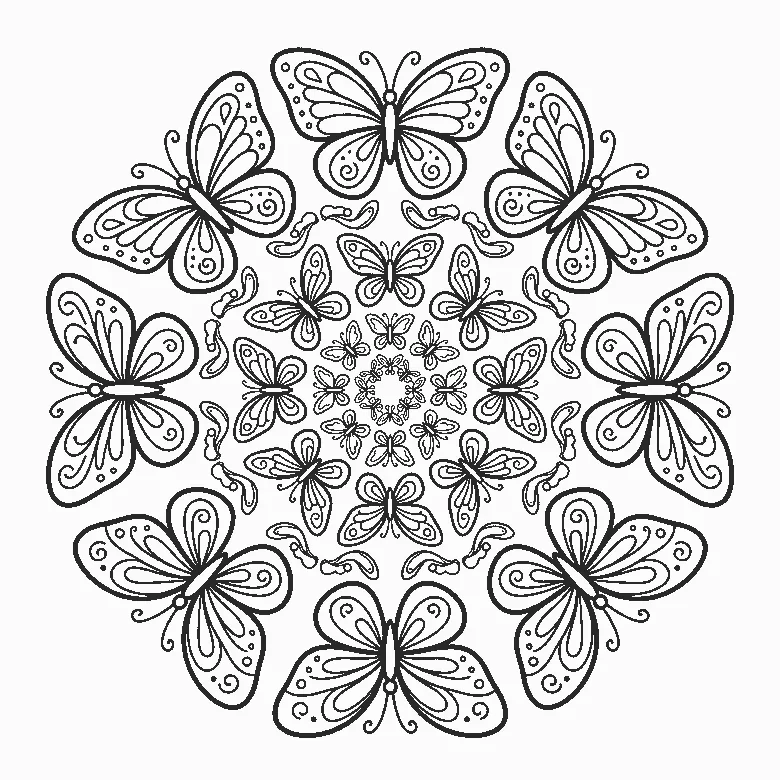
Butterfly mandala coloring page
Four rings of butterflies in one circle, drawn as clean black outlines and free to print on letter paper.
Coloring outline drawn by us.
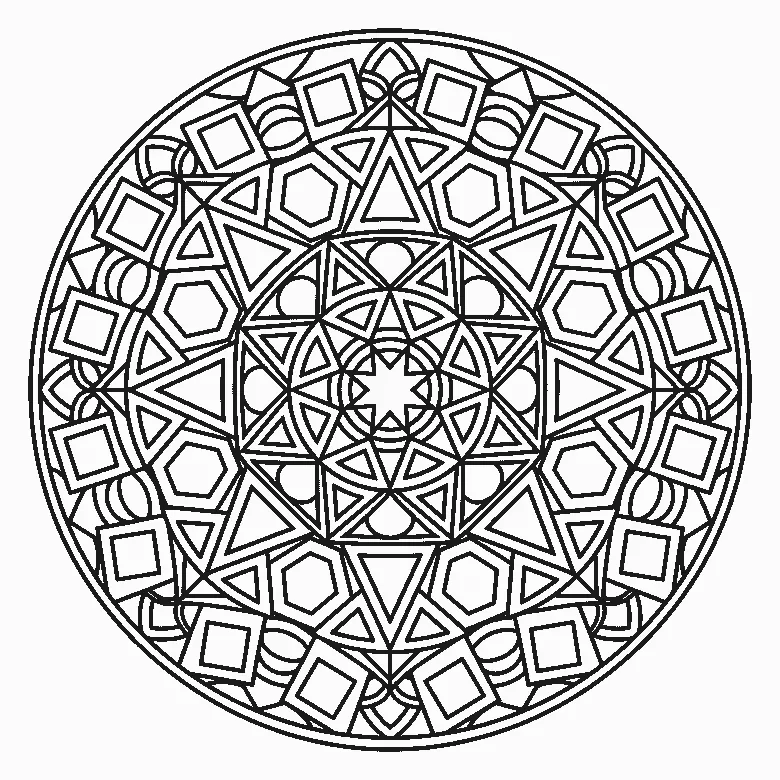
Geometric mandala coloring page
An eight-point star at the center, rings of squares, triangles and pentagons around it, ready to print.
Coloring outline drawn by us.
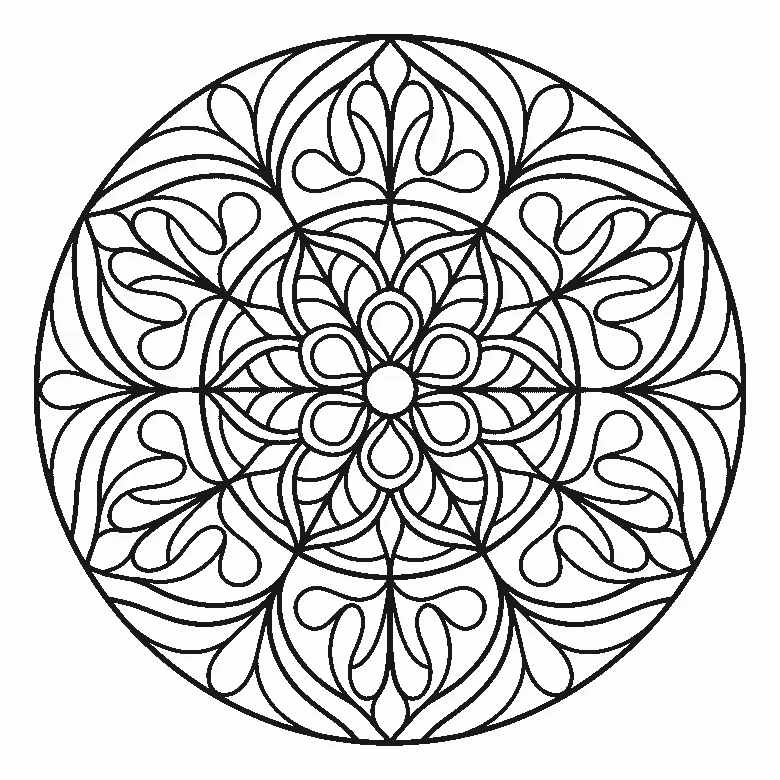
Abstract mandala coloring page
Teardrop and leaf shapes layered in rings around a small round center, on one free letter-size sheet.
Coloring outline drawn by us.


What the mandalas in this section share is a center. Everything else varies: how many rings surround that center, how wide the rings are, whether the repeating unit is a petal or a paw or a plain triangle, and how small the outermost shapes get before the ring closes. A mandala is a design built by repeating one motif around a central point, so each sheet here is really a set of instructions the outline has already followed. Each sheet carries a preview of the whole page, which makes those differences legible before you commit any paper to one of them.
The heart mandala, the star mandala, and the flower mandala are each built from few repeats and wide open shapes. The heart mandala turns on a ring of six hearts, all the same size, all pointing outward from the middle, with generous space between them. The star mandala works in points rather than curves, so its wedges come to sharp tips and the shapes between the points read as separate diamonds. The flower mandala runs entirely on curves, with rounded petals stacked in layers that overlap slightly where each ring meets the next. If someone is coloring a mandala for the first time, one of these three is the sensible pick.
At the other end of the range sits the geometric mandala, which packs its rings and its border with small separate enclosed areas throughout. Its rings are built from straight lines only: triangles inside triangles, narrow bands split into segments, a border of small repeating squares. Filling it completely is a project rather than an afternoon, and the outermost band contains shapes narrow enough that a marker tip covers two at once. Anyone who likes the idea of a long sitting with a sharpened colored pencil will find it here. Anyone who wants a finished page quickly should look elsewhere in the grid.
The animal mandala and the butterfly mandala both take a recognizable creature and bend it into the repeating structure. In the animal mandala the motif is a simple animal head repeated around the ring, so the same face appears again and again at the same angle to the center. The butterfly mandala uses whole butterflies with their wings spread, arranged so that the wing tips of each one nearly touch its neighbors. Both give you the option of making every repeat identical or making every repeat a different color, and those two decisions produce sheets that barely look related when finished side by side.
The abstract mandala is the odd one out and deliberately so. It has no petal, no animal, no star, no obvious real-world reference at all: just curved and straight forms interlocking around the center in a pattern that reads as ornament rather than as a picture of anything. That leaves the color wide open on this sheet, because nothing in the drawing points at a thing with a settled color. It also leaves the planning open, since nothing in the drawing tells you which areas belong together. It can be colored ring by ring, or by shape family, or by whatever pencil is nearest to hand.
A useful way to choose between them is to think about symmetry rather than subject. Every sheet here is symmetric around its center, but they differ in how many times the pattern repeats before it comes back around. Fewer repeats mean larger individual shapes and a bolder finished page. More repeats mean smaller shapes, finer detail, and a result that reads as texture from across the room. The heart mandala sits at the low end with six units in its main ring; the geometric mandala sits at the high end. Everything else falls between those two poles.
Medium matters more on a mandala than on most drawings, because the enclosed areas are small and the outlines sit close together. Colored pencil is the safest choice across all of them, since it layers, it can be kept sharp, and it stops where you tell it to. Markers move fast and give flat even fills, which suits the wide rings on the flower and heart sheets, but they can bleed under a line and merge two shapes that were meant to stay apart. Crayon works on the large open areas and struggles in the narrow bands. Gel pens are worth keeping for the smallest outer shapes on the geometric sheet.
They all print the same way: plain letter paper, actual size rather than fit-to-page, so the border stays a consistent distance from the paper edge. If you plan to use markers, feed the printer something heavier than copy paper and the reverse side stays clean. Printing two copies of the same mandala is worth doing on purpose here, because the repeating structure lets a second color plan run across identical rings and show exactly what changed. A finished mandala also holds up well trimmed into a square and taped to a window, where light through the paper picks up the layered pencil work.
Published Updated 7 sheets836 words