
PDF · A4 · 36 KB · Free, no sign-up. For home and classroom use.
Geometric mandala colouring page
An eight-point star at the centre, rings of squares, triangles and pentagons around it, ready to print.
Start at the middle. An eight-point star sits at the centre of this geometric mandala, and every ring around it is built from flat shapes rather than curves: squares set corner to corner, triangles pointing outward, pentagons spaced evenly around the circle, and a band of half-discs that gives the design its only rounded edges. A double rule runs around the outside, two circles with a narrow channel between them, closing the whole arrangement off from the white margin.
Because the shapes are geometric, the sheet is full of clean, flat areas with hard borders, and that changes how colour behaves on it. There is no soft edge anywhere to hide a wobble, so a fill that stops short of the line is visible, and so is one that crosses it. The upside is that these shapes are easy to fill evenly. A square wants one flat colour. A triangle takes one flat colour and looks finished. Nothing here needs blending to look complete.
A quick method that suits this design: give every shape of the same kind the same colour. All squares one colour, all triangles another, all pentagons a third, half-discs a fourth, star at the centre a fifth. The result is a clear, poster-like circle that shows the structure of the pattern at a glance from across a room. The slower method is to colour by ring instead of by shape, which hides the shape families and makes the mandala read as bands of colour radiating out.
Markers are unusually well suited here. Flat geometric areas are exactly what a broad marker tip fills without streaking, and the heavy outlines give a broad tip a clearly marked lane to stop against on every side. Coloured pencils work too, but a large square filled with pencil shows every stroke direction, so keep your strokes running the same way inside each shape. Crayon over a big flat area tends to skip, which leaves a broken texture sitting against these hard edges.
The double outer rule is easy to leave out of the plan, and it is worth a decision. Left white, it frames the mandala like a mount. Filled dark in both circles, it turns the design into a medallion. Filled in only the narrow channel between the two lines, it becomes a thin bright ring that separates the pattern from the page. It is a small area, so a fine tip or a sharp pencil point does better there than anything broad.
Eight-point stars come up again and again in tiled and woven patterns, and the reason is simple geometry: a circle divides evenly into eight, so eight points space themselves without any awkward remainder. The same evenness is what lets the squares, triangles and pentagons in this drawing line up in tidy rings instead of drifting. Counting the shapes in a single ring before you start is worth the moment it takes, since a repeating colour sequence closes cleanly only when your number of colours divides into the number of shapes in that ring.
Send it to the printer on ordinary A4 paper, set to actual size, so the double outer rule keeps its true circle and does not get cropped or squeezed into an oval. Card is the better choice if you plan to use markers, and it also makes the sheet stiff enough to stand on a shelf later. Printing more than one copy is worth it here, because the same pattern coloured under two different rules looks like two different drawings.
When it is finished, this one holds up as a flat piece of graphic art. Cut along the outer circle and it works on a folder cover or a notebook front, where the hard shapes survive being seen small. Left whole on the page, the white margin already frames it well enough to pin up without any trimming. It is also a straightforward sheet to sit down and redo, because the colour plan is a rule you can write down and change.
Look across the whole of this drawing and there is not one organic shape anywhere in it. There are no petals, no wings, no leaves, nothing that suggests a real object with a real colour, which leaves the palette entirely open and puts all the interest in the arrangement. If you want a drawing where the decisions are about contrast and repetition rather than about what something is supposed to look like, this is the one to print.
Before you print
- Colour every shape family the same, all triangles one colour and all squares another, and the structure of the rings jumps out.
- Fill only the narrow channel between the two outer circles for a thin frame that keeps the rest of the border white.
- Keep your pencil strokes running one direction inside each square, since flat geometric areas show every change of angle.
- Save the eight-point star at the centre for last and give it the strongest colour on the sheet.
- Count the shapes in a ring before starting a repeating colour sequence, so the pattern closes instead of breaking at the end.
Published Updated 747 words
More in this section
Abstract mandala colouring page
Teardrop and leaf shapes layered in rings around a small round centre, on one free A4-size sheet.
Colouring outline drawn by us.
Flower mandala colouring page
Eight petals of leaf sprigs around a ringed centre, held inside a scalloped border for slow, quiet colouring.
Colouring outline drawn by us.
Animal mandala colouring page
A circular mandala of paw prints and rounded ear shapes around an eight-petal flower, free as an A4-size PDF.
Colouring outline drawn by us.
Heart mandala colouring page
One heart on a starburst at the centre, ringed by two rows of larger hearts pointing inward. Free A4-size PDF.
Colouring outline drawn by us.
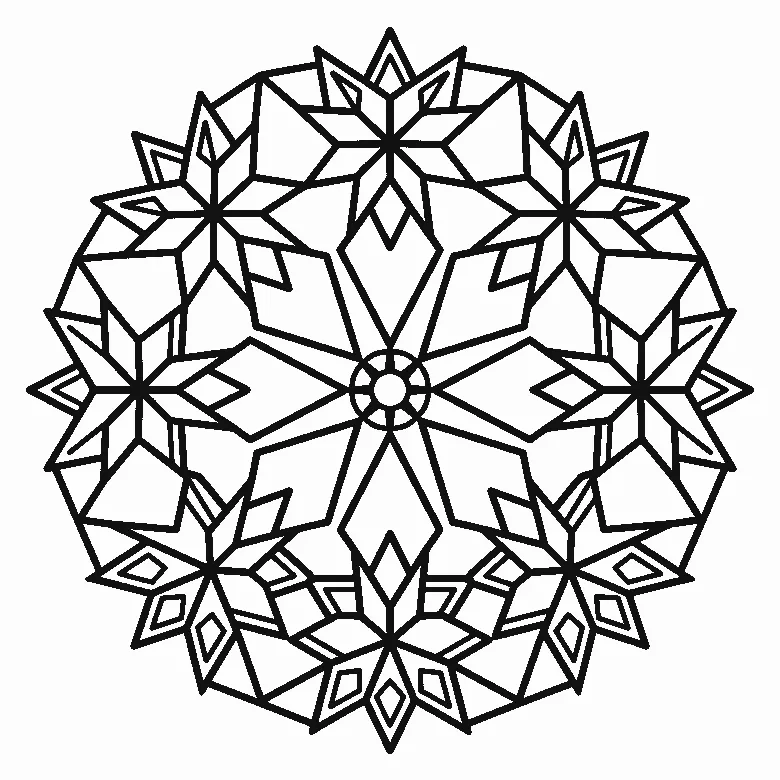
Star mandala colouring page
Eight-pointed stars and faceted diamonds in rings around a small ringed centre, free to print on A4 paper.
Colouring outline drawn by us.
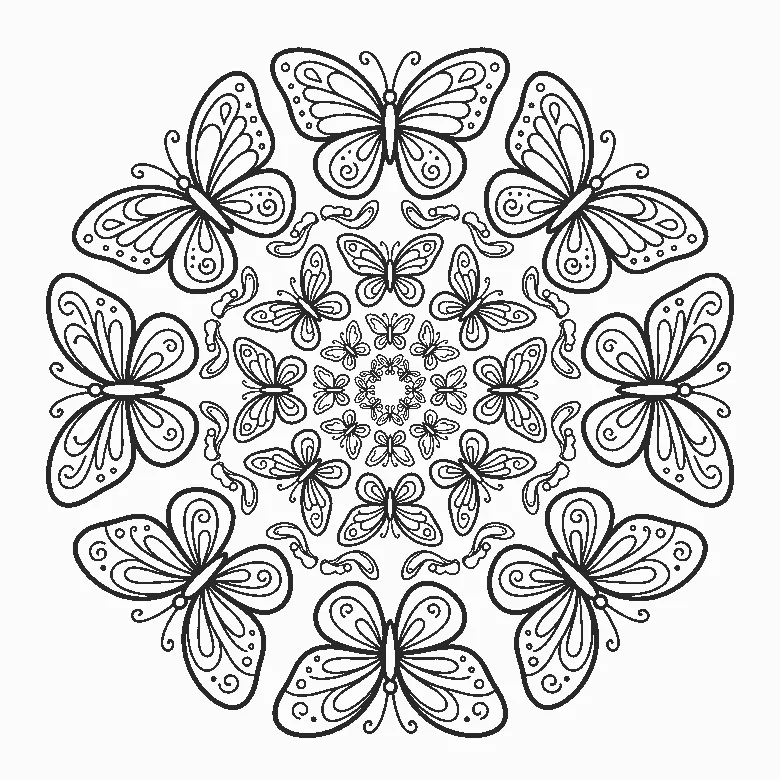
Butterfly mandala colouring page
Four rings of butterflies in one circle, drawn as clean black outlines and free to print on A4 paper.
Colouring outline drawn by us.


