Ocean
Sharks, dolphins, turtles and the strangest amphibian in the pond, each on its own printable sheet.
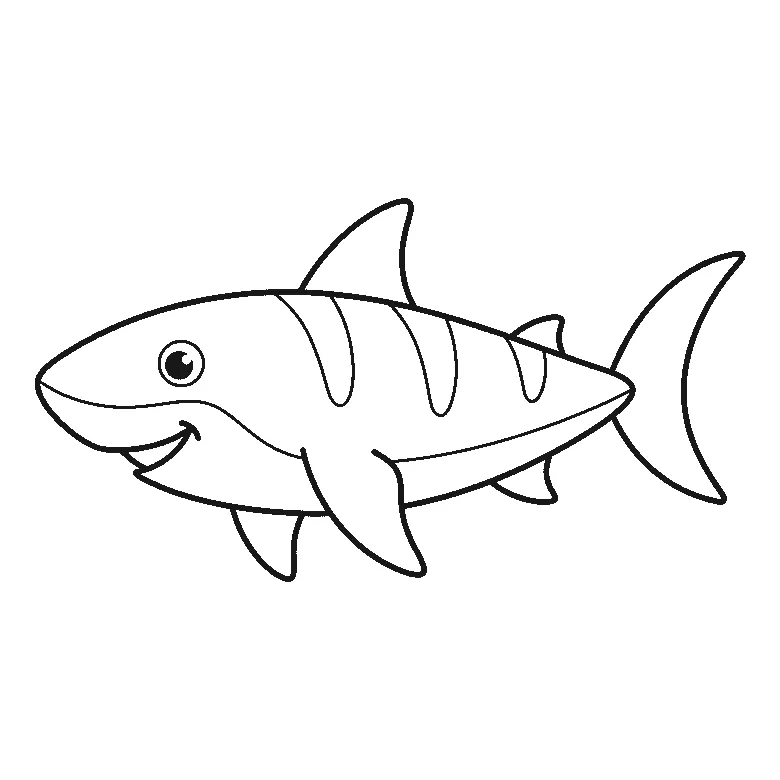
Shark colouring page
One shark in profile, tall dorsal fin to crescent tail, printable on A4 paper with no background.
Colouring outline drawn by us.

Dolphin colouring page
A leaping dolphin above three wave lines, drawn in thick black outline and free to print as an A4 PDF.
Colouring outline drawn by us.
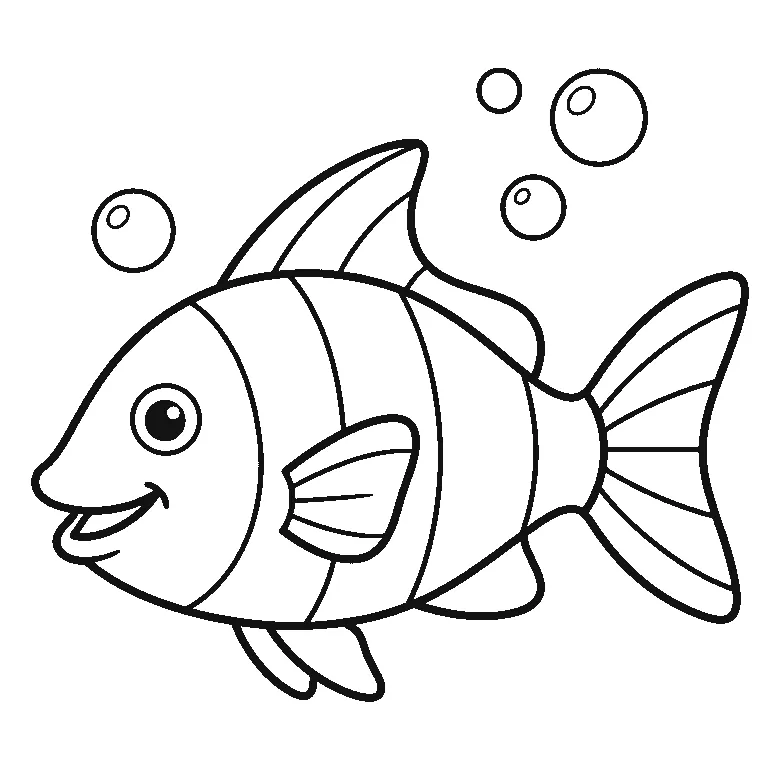
Fish colouring page
A broad striped tropical fish with three bubbles beside it, free to print at full A4 size in clean outline.
Colouring outline drawn by us.
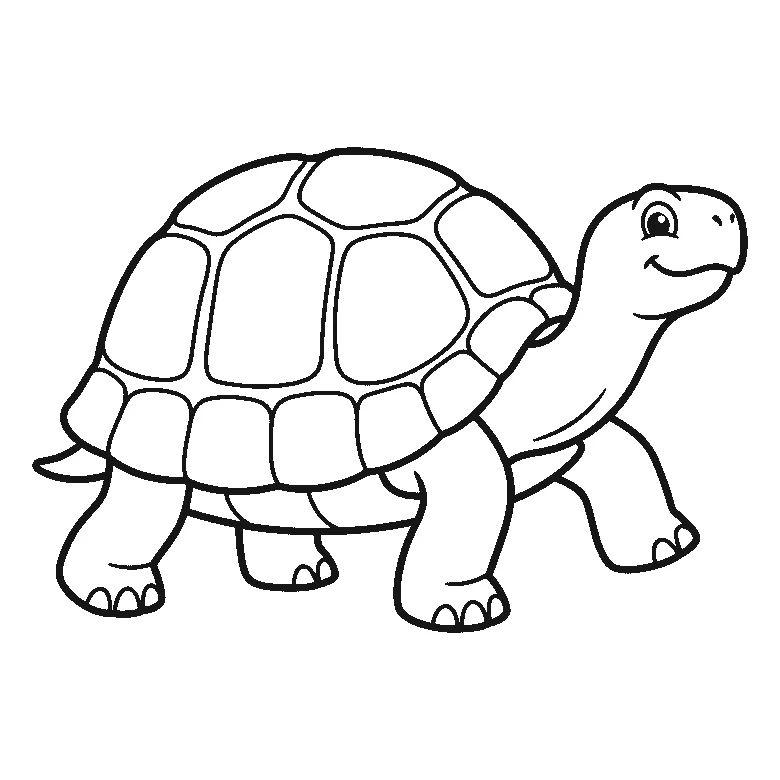
Turtle colouring page
A turtle mid-step with a large domed shell divided into plates, ready to print free on A4 paper.
Colouring outline drawn by us.
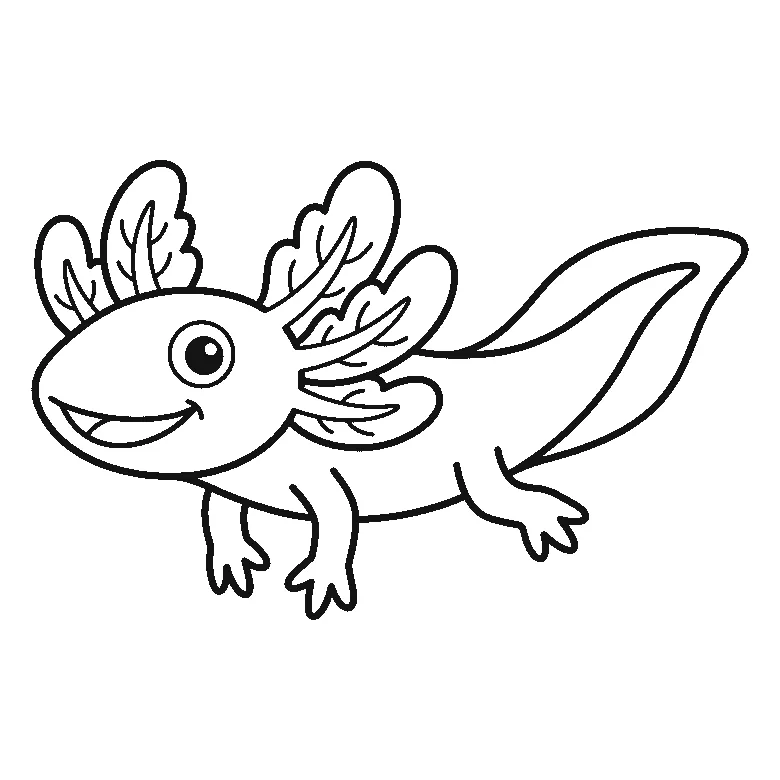
Axolotl colouring page
A side-view axolotl with feathery gills and a finned tail, drawn in thick black outlines for A4 paper.
Colouring outline drawn by us.


This section is grouped less by geography than by the feeling of drawing something that moves through water. Most of it belongs to the sea: a shark, a dolphin, a fish, and a turtle. The axolotl belongs to fresh water and stays here because it swims and because its long-bodied outline sits comfortably beside the sea shapes. Each one is a separate printable page with its own outline, so nothing has to be chosen in advance.
The shark sheet is built out of straight runs and hard angles. Its body reads as a long wedge, the dorsal fin sits high on the back as a clean triangle, and the tail splits into two unequal lobes. Sharks have skeletons of cartilage rather than bone, which is part of why their outlines curve so smoothly, and the drawing leans into that: few interior lines, a broad flank left almost entirely open, and a gill area near the head where a set of short parallel strokes adds a band of fine detail close to the eye.
The dolphin takes the opposite approach. Everything about that outline is curve, from the rounded forehead down the back to the narrow stalk before the tail flukes. A dolphin breathes air through the blowhole on top of its head, and the sheet marks that spot, which turns out to be a useful landmark when deciding where the darker back should fade into the paler belly. The flank runs unbroken from head to tail, which leaves a long stretch of paper for blending two tones into each other with no interior line to stop at.
The fish sheet is broken into many small shapes, and deliberately so. Instead of one large body to fill, it offers a shape broken into scales, fins with visible rays, and a rounded eye that sits inside its own ring. Small enclosed areas reward a coloured pencil kept sharp and punish a thick marker tip, which tends to jump the line and flood two scales at once. It is the page to reach for when the appeal is repetition: filling one small shape after another, changing the shade slightly each time.
The turtle is built out of compartments. Its shell is divided into plates called scutes, and those divisions give the sheet a natural map, each section closed and ready for a different treatment. Around the shell, the head, four flippers, and a short tail sit in the open, larger and simpler than the plates above them. It suits anyone who wants both kinds of colouring on one page, since the shell can take patient work while the flippers can be filled quickly with a crayon held flat.
The axolotl is the odd one, and it earns its place. It keeps its feathery external gills all its life, three branching stalks on each side of the head, and the drawing gives those stalks real width so they can be coloured rather than merely traced. Its face carries a wide, permanent-looking curve of a mouth. Pale pink suits the animal it was drawn from, though the outline takes an inky purple or a deep green just as well, and there is nothing on the sheet that argues against either.
As a set, the pages differ most in how much open space they hand over. The shark and the dolphin are mostly broad, uninterrupted flank, which suits watercolour pencil worked wet or a crayon dragged in one direction. The fish and the turtle break their surface into small closed shapes, better suited to pencils layered from light to dark. The axolotl sits between them, with a large simple body and a fringe of fine detail at the head, so a single page can use two tools without looking inconsistent.
For printing, plain A4 paper handles every sheet here. Choose actual size rather than fit-to-page so the outlines stay the weight they were drawn at, and switch to thicker card if markers are the plan, since a marker will otherwise show through and lift ink onto whatever is underneath. Printing two copies of the same page lets two people work side by side and compare what they did with the same lines. Finished sheets tape well to a window, where the paper thins the light and the darker areas read as silhouettes.
Published Updated 5 sheets716 words