
PDF · A4 · 29 KB · Free, no sign-up. For home and classroom use.
Abstract mandala colouring page
Teardrop and leaf shapes layered in rings around a small round centre, on one free A4-size sheet.
This abstract mandala is not a picture of anything. Curved teardrop shapes and pointed leaf shapes are layered in rings around a small round centre, each ring overlapping the one before it slightly, and a plain outer circle closes the design. No flowers, no animals, no lettering. Just black outlines on white and a lot of enclosed curves, which is exactly what makes it a forgiving sheet to sit down with when you do not want to think about whether something looks right.
The centre is small, barely wider than a coin, and it is the tightest area on the page. Everything else opens up from there. The teardrops give you medium areas with a fat end and a narrow tip, and the pointed leaf shapes sit in their own rings as broader, more open fills to work across. That gradient from small to large is the drawing's main feature, and it means the page gets easier to colour the further out you work.
Because the shapes overlap, every seam on this sheet is a decision point: you can colour the overlaps as their own small areas, or you can carry one colour straight through an overlap so two shapes read as one. Doing the first gives a stained-glass look with dozens of tiny slivers between the big shapes. Doing the second flattens the design and makes the rings feel like solid petals. Try one of each on two copies before deciding which you prefer.
Curved shapes are where blending pays off. A teardrop takes colour beautifully if you press hard at the wide end and lift as you move towards the point, letting the paper show through near the tip. Watercolour pencils do this without much effort, and a barely damp brush pulled from the wide end towards the narrow one will even out the grain. Dry coloured pencil gives you the same effect with more control and no risk of buckling the paper.
There is no correct palette here, because there is nothing on the sheet to be faithful to. One approach runs a single colour family right through, from pale at the centre to deep at the rim, and the result looks like one object seen in cross section. Another alternates two colours ring by ring for a woven effect. A third approach is to leave every other shape white, which sounds like less work but reads as deliberate and keeps the outlines doing most of the design.
Symmetry is doing quiet work on this page. Each ring repeats the same shape at even intervals around the circle, so if you commit to a colour sequence and follow it around, the sequence closes back on itself where it started. If you lose track partway, the fix is not to start over. Pick the sequence up again from wherever you are, and the eye reads the break as part of the pattern rather than as a mistake.
A4 paper at actual size prints it correctly, with the plain outer circle intact and even white on all four sides. Heavier card is an option with markers, since the small overlap slivers are where marker ink can pool and work through to the back. If two people are colouring, print two copies rather than sharing one, because the layered rings make it awkward for two hands to work the same sheet without knocking into each other.
Finished, this one suits being cut out along the plain outer circle. Without a decorated border there is nothing to lose by trimming it, and a bare disc of colour mounted on a plain background looks intentional. It also scans and photographs well, since there are no fine hatching lines to disappear. If you would rather keep it flat, the untouched margin gives you room to write the date in a corner and stack it with the other sheets from this section.
This section also holds mandalas built from things you can name, butterflies set in rings and squares and triangles arranged in tidy families. This one is built from shapes with no name attached, which puts every decision on you and takes none of them away. That is either the appeal or the problem, depending on the day. If a sheet with an obvious right answer suits you better right now, the named mandalas are in this section too.
Before you print
- Press hard at the wide end of each teardrop and ease off towards the point to get shading without changing pencils.
- Decide early whether the overlap slivers get their own colours or disappear into the shape beside them.
- Leave the small round centre white until the end, then choose the colour that the finished rings are asking for.
- Use a fine tip in the overlaps, where a broad marker will flood two shapes at once and pool through the paper.
- Work outward from the centre so your hand rests on uncoloured paper instead of on shapes you have already filled.
Published Updated 726 words
More in this section
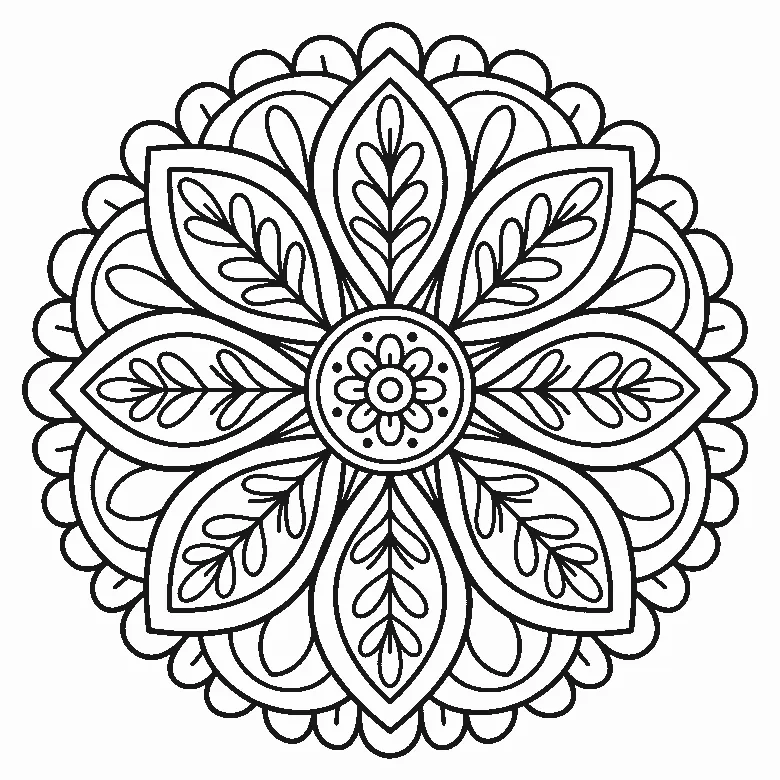
Flower mandala colouring page
Eight petals of leaf sprigs around a ringed centre, held inside a scalloped border for slow, quiet colouring.
Colouring outline drawn by us.
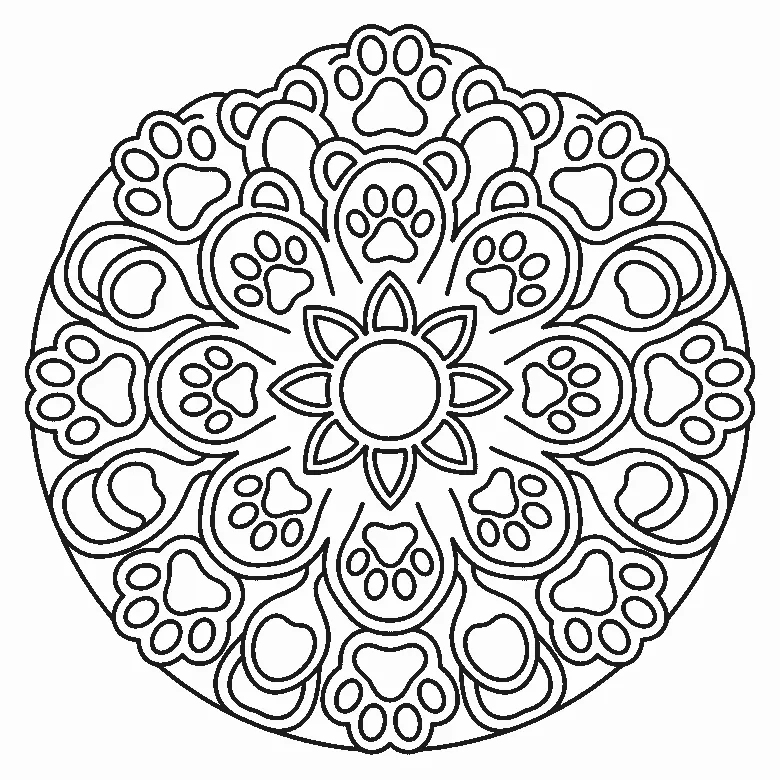
Animal mandala colouring page
A circular mandala of paw prints and rounded ear shapes around an eight-petal flower, free as an A4-size PDF.
Colouring outline drawn by us.
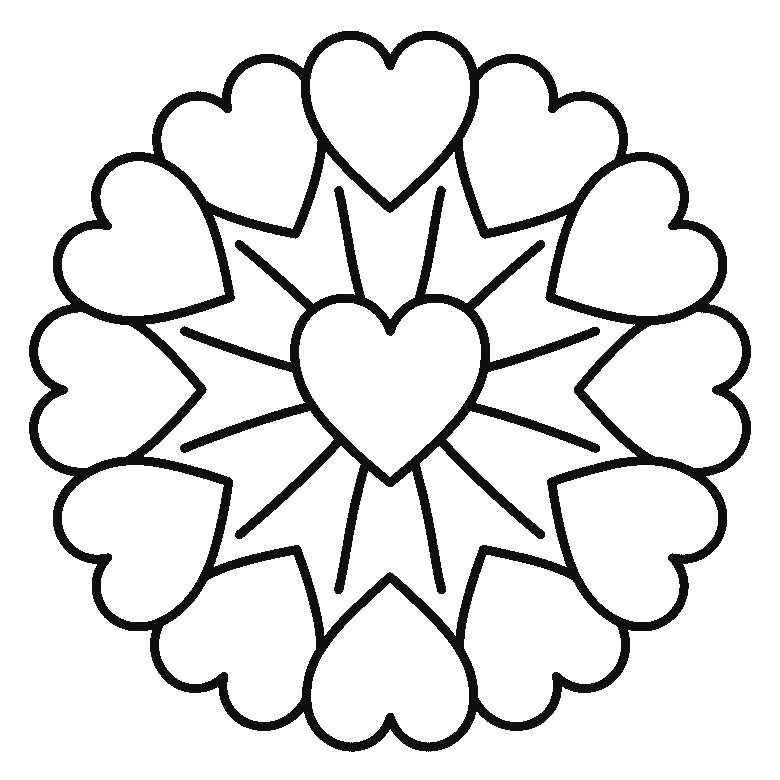
Heart mandala colouring page
One heart on a starburst at the centre, ringed by two rows of larger hearts pointing inward. Free A4-size PDF.
Colouring outline drawn by us.
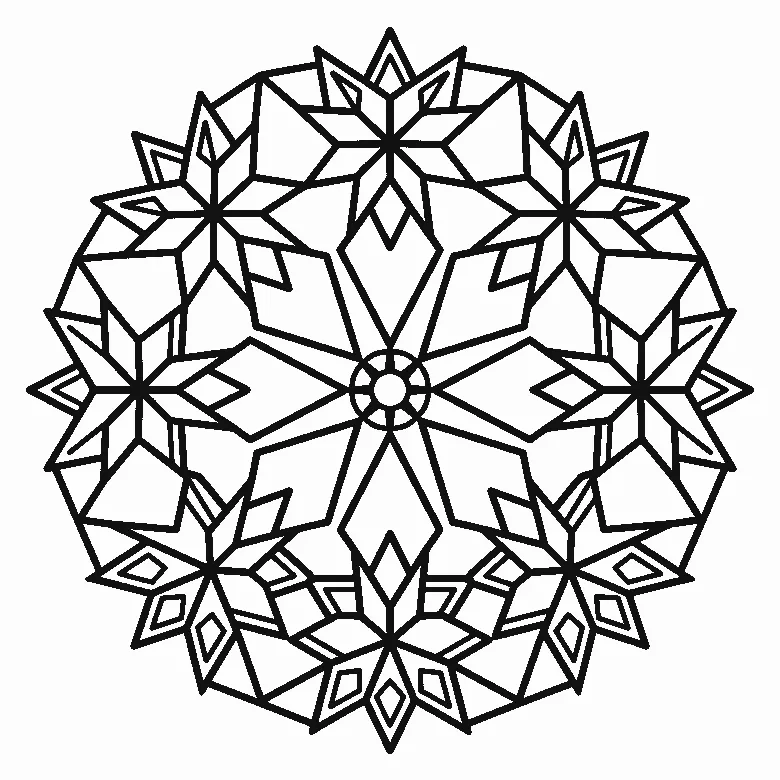
Star mandala colouring page
Eight-pointed stars and faceted diamonds in rings around a small ringed centre, free to print on A4 paper.
Colouring outline drawn by us.
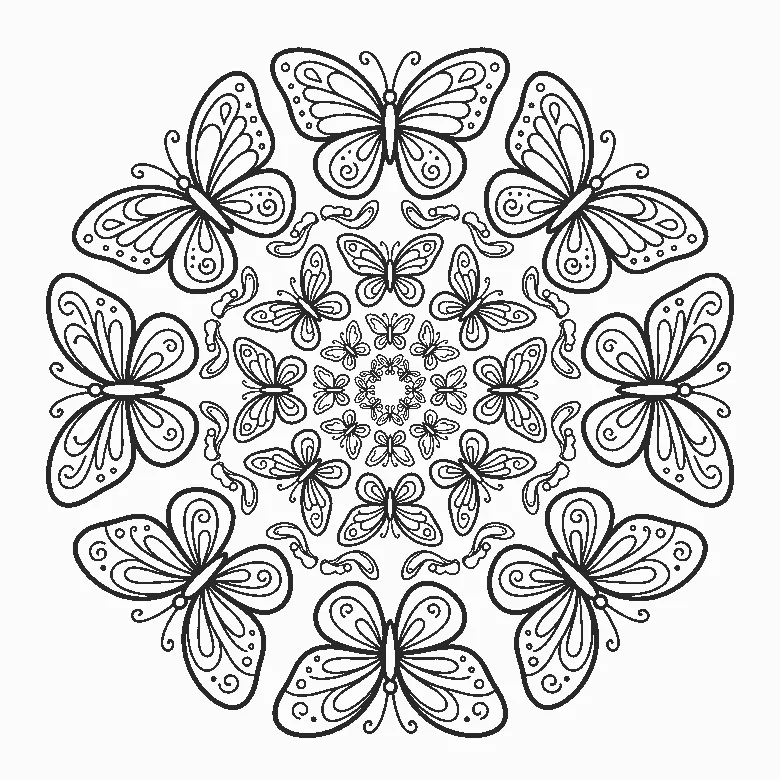
Butterfly mandala colouring page
Four rings of butterflies in one circle, drawn as clean black outlines and free to print on A4 paper.
Colouring outline drawn by us.
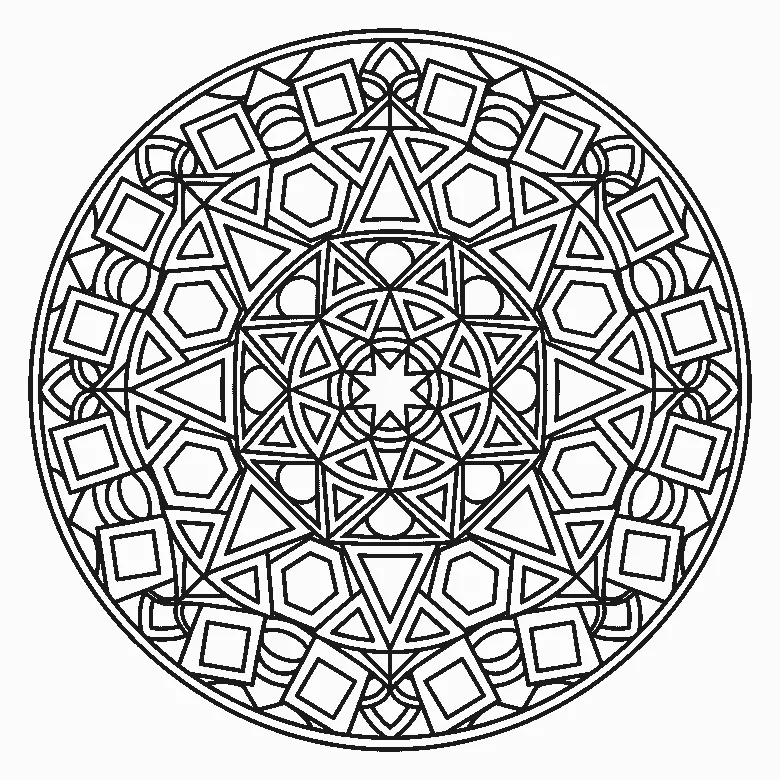
Geometric mandala colouring page
An eight-point star at the centre, rings of squares, triangles and pentagons around it, ready to print.
Colouring outline drawn by us.


