
PDF · A4 · 30 KB · Free, no sign-up. For home and classroom use.
Flower mandala colouring page
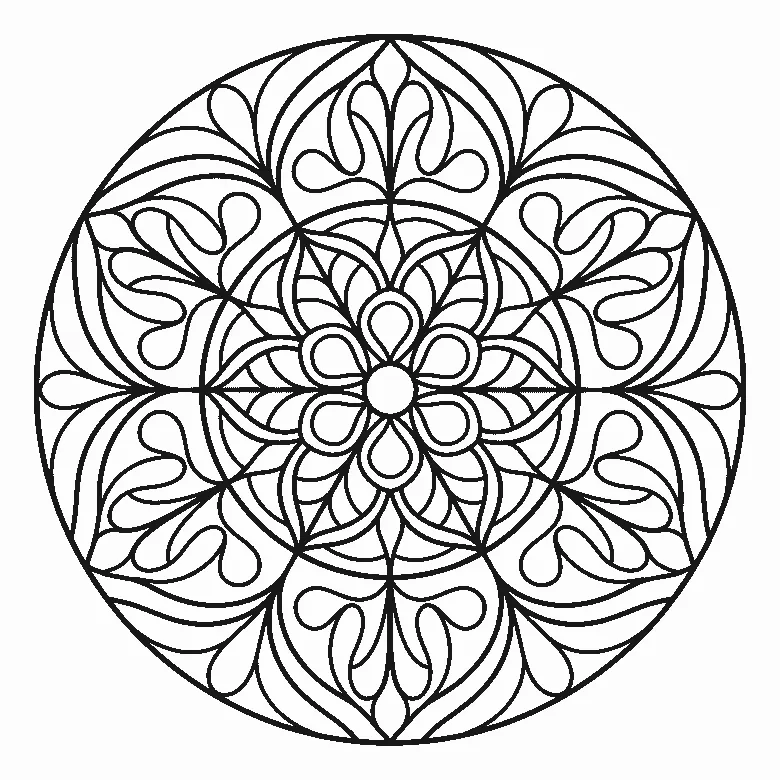
Eight petals of leaf sprigs around a ringed centre, held inside a scalloped border for slow, quiet colouring.
Eight large pointed petals radiate from the middle of this mandala, and each one is filled with a sprig of small leaves. At the centre sits a compact set of rings, one inside the next. The whole flower is enclosed by a scalloped outer border that runs around the page in a chain of shallow curves. Everything is drawn in black outline on white, with no shading and no stippling, so each closed shape is a clean area waiting for a colour and nothing has to be worked around.
The structure gives an easy way in. Because the eight petals repeat the same shape and the same leaf sprig, whatever is done to one can be done to the other seven, and the page begins to look deliberate very quickly. One route is to work petal by petal all the way around. Another is to colour one element at a time across the whole design, all eight petal bodies first, then all the leaves, then the rings, then the border. The second method holds the pattern together better and makes it much less likely that a colour runs out partway through.
Symmetry is the tool this drawing hands over. Colouring every petal the same gives a calm, even flower. Alternating two colours around the ring gives a windmill effect that the eye reads as movement. Colouring opposite pairs to match, so petals one and five agree, then two and six, sets up a quieter kind of rhythm. Any of these can be planned in advance with a light dot of colour in each petal before committing, which takes a minute and saves the frustration of realising at petal seven that the sequence went wrong at petal three.
The leaf sprigs are the small work. Each leaf is a narrow shape and there are many of them, so a broad tip will bridge from one leaf to the next and lose them. A well sharpened coloured pencil is the natural choice here, and a fine gel pen is even better if the aim is contrast against a filled petal. Keeping the pressure light on these small shapes also matters because heavy wax builds a slick surface that later colours will not sit on top of, and layering is the main advantage a pencil has.
The ringed centre is the smallest area on the sheet and important enough to be worth thinking about. A dark core with lighter rings around it pulls the eye inward. The reverse, light at the very middle, makes the flower look as though it is opening. The scalloped border does the opposite job: it closes the design off, and colouring every scallop the same tone frames everything inside. Leaving the scallops white and colouring only the thin space between them and the petals gives the page air.
Mandalas are circular by definition, and the arrangement here follows the way a real flower is built, with parts arranged evenly around a central point. Petals in a ring of eight, leaves paired along a stem, rings inside rings: those are shapes found all over growing things, which is part of why the design feels familiar before a single colour goes on. Nothing about the sheet is botanical in a strict sense, though. The leaf sprigs belong to no particular plant, which leaves the choice of green, or not green, entirely open.
Watercolour pencils suit this drawing especially well. Laid down dry and then touched with a barely damp brush, they flood a petal evenly in a way dry pencil cannot, and the black outlines are thick enough to hold the colour inside its shape. If water is used, print on heavier card, since the wet areas on a lighter sheet may ripple as they dry. For dry media, plain A4 paper at actual size is fine, and actual size rather than fit-to-page matters here because the leaf sprigs and the inner rings are the first things to close up when the drawing is scaled down.
The shapes on this sheet are drawn generously rather than fine and crowded. The petals are large and there are only eight of them, so the page can be finished in one sitting rather than returned to over several days. The finished circle also lends itself to being given away: trimmed just outside the scalloped border, it mounts onto a folded piece of card, and it can be taped to a window to see how it looks with light behind it, the untouched white areas open and the filled petals dark, which is a different picture from the one seen flat on a table.
Before you print
- Colour all eight petal bodies first, then all the leaf sprigs, so the pattern stays consistent.
- Mark each petal with a light dot of its intended colour before committing to the sequence.
- Keep the pressure light on the leaf sprigs; heavy wax stops you layering a second colour over them.
- Print on card if you plan to wet watercolour pencils, since A4 paper can ripple.
- Leave the scalloped border white if you want the flower inside it to carry all the colour.
Published Updated 770 words
More in this section
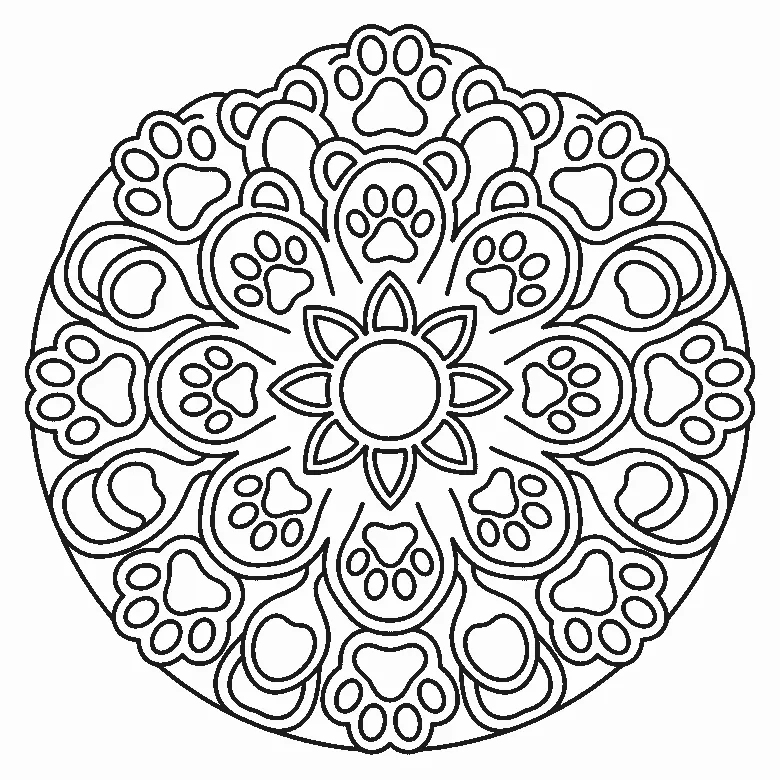
Animal mandala colouring page
A circular mandala of paw prints and rounded ear shapes around an eight-petal flower, free as an A4-size PDF.
Colouring outline drawn by us.

Heart mandala colouring page
One heart on a starburst at the centre, ringed by two rows of larger hearts pointing inward. Free A4-size PDF.
Colouring outline drawn by us.
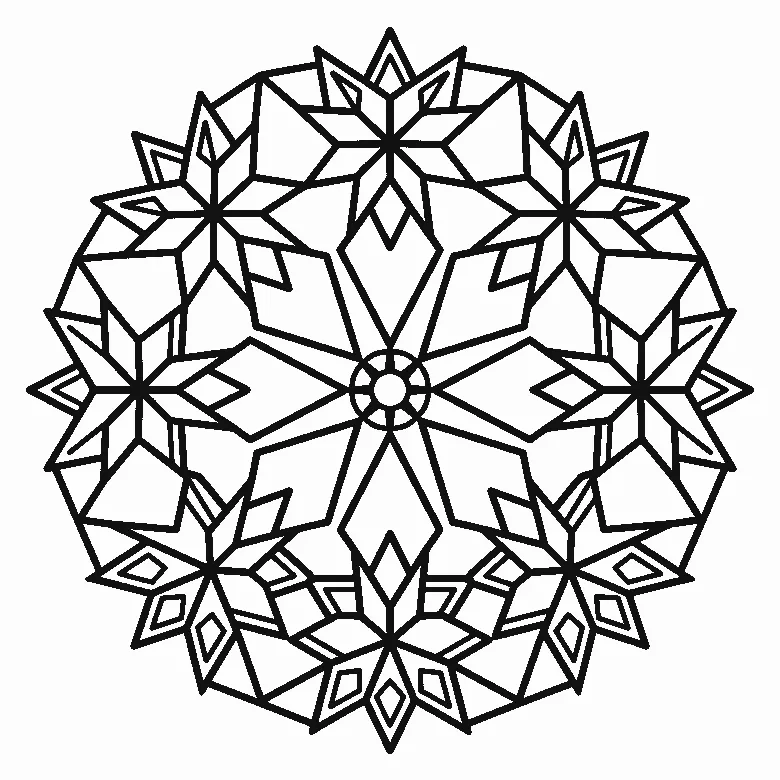
Star mandala colouring page
Eight-pointed stars and faceted diamonds in rings around a small ringed centre, free to print on A4 paper.
Colouring outline drawn by us.
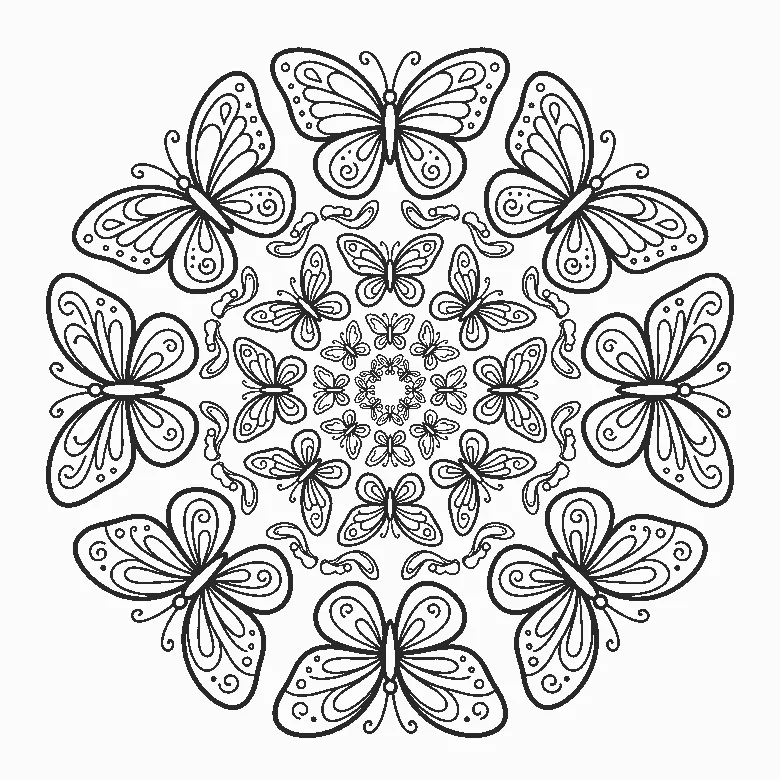
Butterfly mandala colouring page
Four rings of butterflies in one circle, drawn as clean black outlines and free to print on A4 paper.
Colouring outline drawn by us.
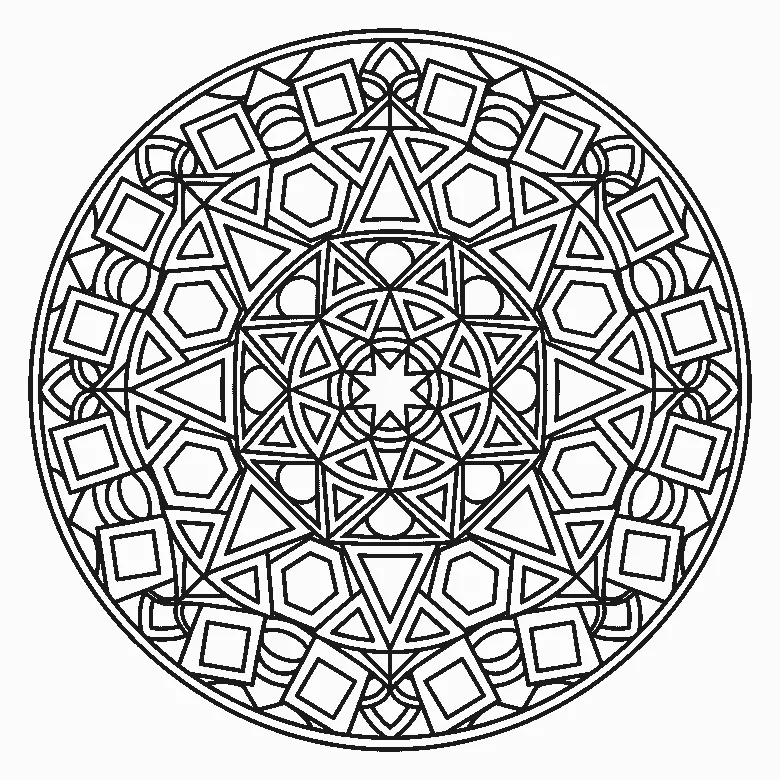
Geometric mandala colouring page
An eight-point star at the centre, rings of squares, triangles and pentagons around it, ready to print.
Colouring outline drawn by us.
Abstract mandala colouring page
Teardrop and leaf shapes layered in rings around a small round centre, on one free A4-size sheet.
Colouring outline drawn by us.


