
PDF · US Letter · 19 KB · Free, no sign-up. For home and classroom use.
Winter coloring page
A snowman in a bucket hat and fringed scarf, mittens on a cord, three snowflakes and a wooden sled.
Four things share this page and none of them overlap: a snowman wearing a bucket hat and a fringed scarf, a pair of mittens strung on a cord, three snowflakes, and a wooden sled. There is no snowbank under any of it and no sky behind it. That is deliberate. Leaving the background empty lets whoever picks up the pencil decide whether the day is bright or overcast, and it keeps the sheet from turning into one large flat field of blue to fill in before anything else can happen.
The snowman is the tall shape in the group, built from stacked rounds with a carrot nose pushed into the upper one. The carrot is the one part of him with an obvious color, and it is small, which makes it a useful anchor: put the orange down first and everything else on the figure gets chosen against it. His body is meant to stay mostly white. Snow on white paper is less a problem to solve than a decision to make early, before the hat and scarf are settled.
The hat is a soft bucket shape with a turned brim rather than a stiff top hat, and it sits down over the head instead of perching on it. The scarf crosses the neck and hangs down one side, ending in a fringe of separate strands. Those strands are the finest lines on the sheet, and they are the place where a sharpened colored pencil will beat a thick marker. Hat and scarf are the two spots on the figure where a bold color can go without competing with the carrot.
The mittens hang below, joined by a cord that loops between them the way a cord does when it has been threaded through a coat. Each mitten has a thumb set off from the body and a cuff at the wrist, so there are three areas per mitten if you want to break them up. A pair asks a question the rest of the page does not: matched or not. Coloring them identically makes them read as one object, and giving the cuffs a second tone makes them read as knitwear.
Three snowflakes are spaced around the group at different sizes. Each is built on six arms with small branches coming off them, which is how a snowflake is actually put together, and each of the three carries its own branching pattern. They are open shapes with a great deal of white between the lines, so they are better traced than filled. Running a pale blue or gray along the arms and leaving the paper alone between them keeps them looking like ice rather than like flowers.
The sled is drawn from the side, with wooden slats across the seat, upturned runners and a pull rope at the front. The slats give it a run of parallel bands, and that repetition is the one place on this sheet where a steady rhythm pays off: alternate two close browns across the slats and wood grain appears without a single extra line being drawn. The runners underneath are thin and want a different tone from the seat, or the sled flattens into one solid brown block.
This is a sheet for a day that keeps everyone indoors. It sits well on the table while something is heating on the stove, and it has parts worth cutting out afterward. The three snowflakes come off the page cleanly and tape to a window at whatever height suits the shortest person in the house. The snowman, trimmed with a border left around him, is about the right size for the front of a folded card, and the mittens make a small name marker for a place at the table.
We laid the file out at US Letter with a clear margin, so nothing on it runs into the edge of the paper on a home printer. Everything is black line on white with no filled areas, which means a draft setting prints it as well as a fine one and uses less ink doing it. Copy paper handles pencils and crayons. Card stock is the better choice if the snowman is going to become a card front, because it takes a fold without cracking the color along the crease.
Before you print
- Decide early what the snowman's body will be: bare paper, or the palest gray in the box.
- Color the carrot nose first, then choose the hat and scarf against it.
- Use a sharp pencil for the scarf fringe; a broad marker closes those strands up.
- Trace the snowflake arms and leave the paper white between them.
- Alternate two browns across the sled slats, and give the runners a third tone.
Published Updated 715 words
More in this section
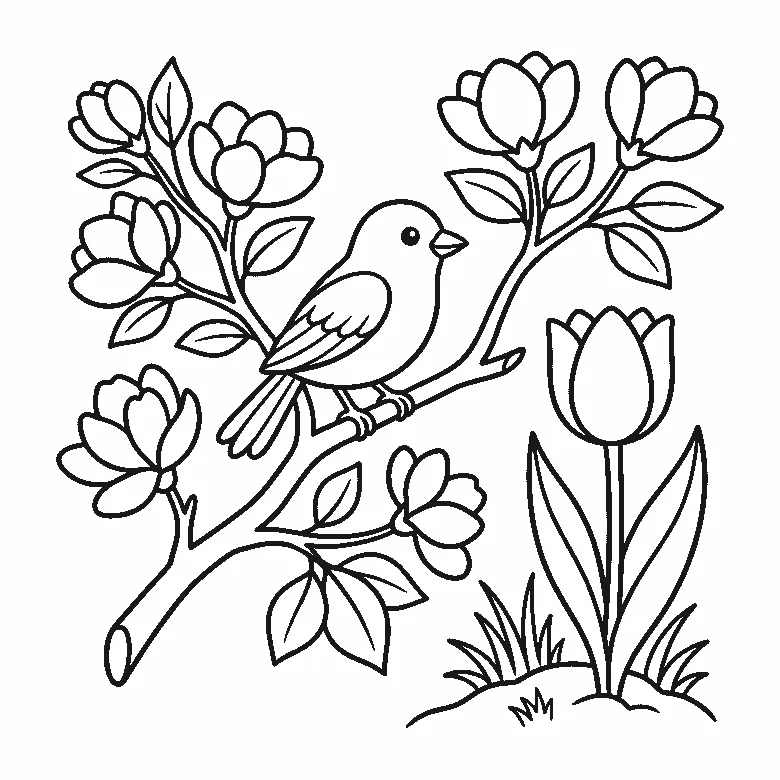
Spring coloring page
A blossom branch with a small bird perched on it, and a tulip rising from a tuft of grass, in black outline.
Coloring outline drawn by us.
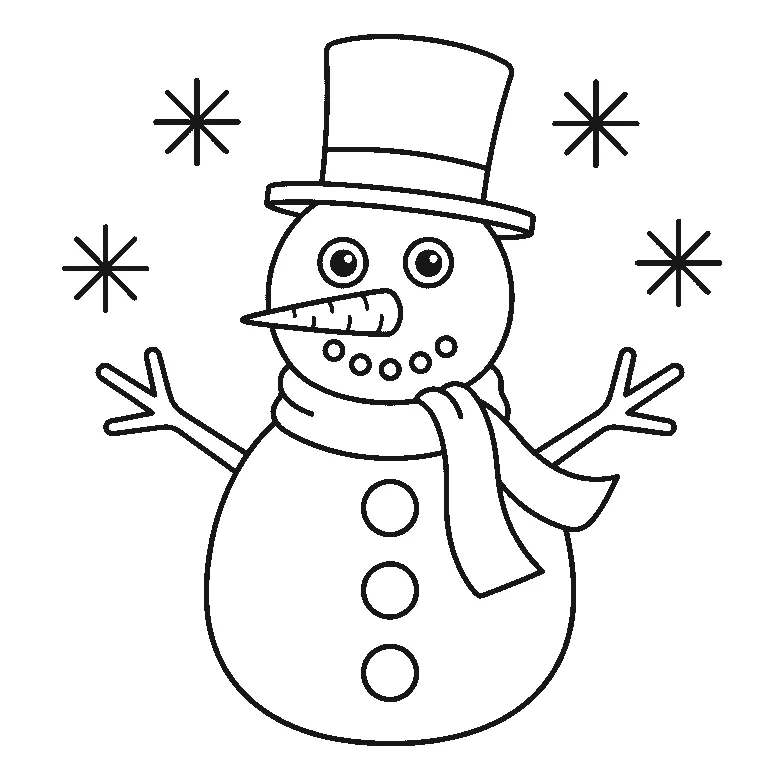
Snowman coloring page
A two-ball snowman in a top hat and scarf, with twig arms and four snowflakes, on one letter-size sheet.
Coloring outline drawn by us.
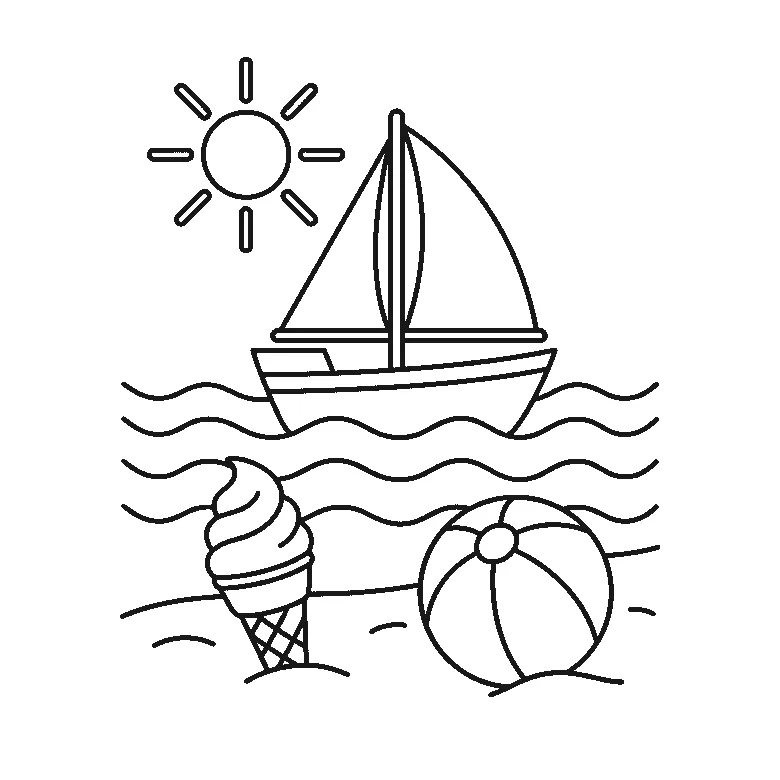
Summer coloring page
A sun, a two-sail boat on waves, an ice cream cone and a paneled beach ball, drawn as one open outline scene.
Coloring outline drawn by us.
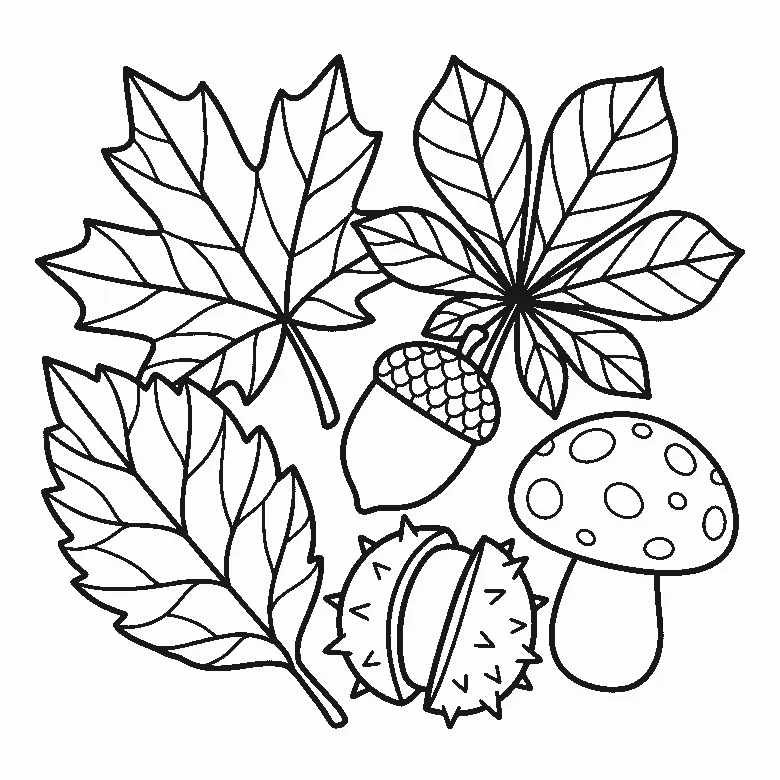
Fall coloring page
A maple leaf, a chestnut leaf, an acorn, a split spiny case and a spotted mushroom, in plain black outline.
Coloring outline drawn by us.


