
PDF · US Letter · 26 KB · Free, no sign-up. For home and classroom use.
Fall coloring page
A maple leaf, a chestnut leaf, an acorn, a split spiny case and a spotted mushroom, in plain black outline.
This sheet gathers a handful of fall finds and lays them out on open white paper: a maple leaf, a chestnut leaf, two more leaves drawn with their veins showing, an acorn still sitting in its cap, a split spiny case from a horse chestnut, and a spotted mushroom. Nothing overlaps into a heap, so each shape keeps its own outline and can be finished on its own. We drew the group as separate objects rather than as a scene, which means there is no ground under them, no horizon and no sky to account for.
The maple leaf is the widest shape on the page. Its lobes come to points, and the notches between them cut deep enough that the outline reads as a maple before any color goes down at all. The veins run out from the base of the leaf toward each point, splitting as they go. Those vein lines divide the leaf into narrow fields, and you can treat each field as its own small area or ignore the divisions entirely and lay one flat tone across the whole blade.
The chestnut leaf next to it is built differently. It is long, tapered and edged with small teeth, with one strong midrib and short veins branching off it at regular intervals like the ribs of a feather. The two remaining leaves are simpler in outline but carry the same vein structure, so all four give a chance to work one idea at four different widths. If the group should look like it came off a single walk, keep the vein lines a single color across every leaf.
The acorn sits low in the arrangement, still wearing its cap. The cap is textured with the small overlapping scales that give an acorn its rough top, and the nut below it is smooth and egg shaped, narrowing to a short point at the tip. That split between rough and smooth is the whole appeal of the shape. A darker tone on the cap and a lighter one on the nut separates the two without any shading skill at all, because the outline has already done the work of dividing them.
The spiny case has cracked open. Horse chestnut cases do that as they ripen, and the drawing catches one part way through, with the two halves parted and the spines standing out around the rim. Inside, the surface is smooth where the nut sat. It is the busiest single object on this page and the one that rewards patience: the spines are drawn as separate small triangles, and outlining them in a slightly darker tone than the shell before filling the body gives the case a proper burr edge.
The mushroom is drawn with a domed cap, a ring of spots across it and a stout stem underneath. The spots are outlined rather than filled, so they stay white unless you decide otherwise, and leaving them as bare paper against a strong cap color is the quickest way to make the mushroom read from across a room. The stem widens slightly at the base where it meets nothing in particular, since there is no ground line here, and that leaves the object sitting cleanly on the open paper.
Fall is a long season with a lot of evenings in it, and this is a sheet for one of them. It works on the table while dinner is in the oven, and it works cut apart afterward. The four leaves can be trimmed out and taped along a window frame; the acorn and the mushroom are small enough to become the front of a folded card or a name marker at a place setting. Cutting the sheet up is a fair use of it, and the objects were spaced with a scissor line in mind.
We built the file at US Letter size with a margin on all four sides, so a home printer will not clip the spines or the leaf tips. The lines are solid black on white with no gray fill anywhere, which prints the same on a draft setting as it does on a high quality one. Plain copy paper is fine for pencils. If markers are the plan, heavier card stock keeps the ink from soaking through onto whatever is under the page, and it also holds a fold if the sheet becomes a card.
Before you print
- Work the maple leaf's vein fields first, while your hand is fresh; they are the narrowest areas on the sheet.
- Leave the mushroom's spots as bare paper and pick a strong tone for the cap around them.
- Give the acorn cap a darker tone than the nut so the rough top separates from the smooth body.
- Outline the spines on the split case in a darker shade before filling the shell behind them.
- If the four leaves are going in a window, color right up to the outline and cut just outside it.
Published Updated 731 words
More in this section
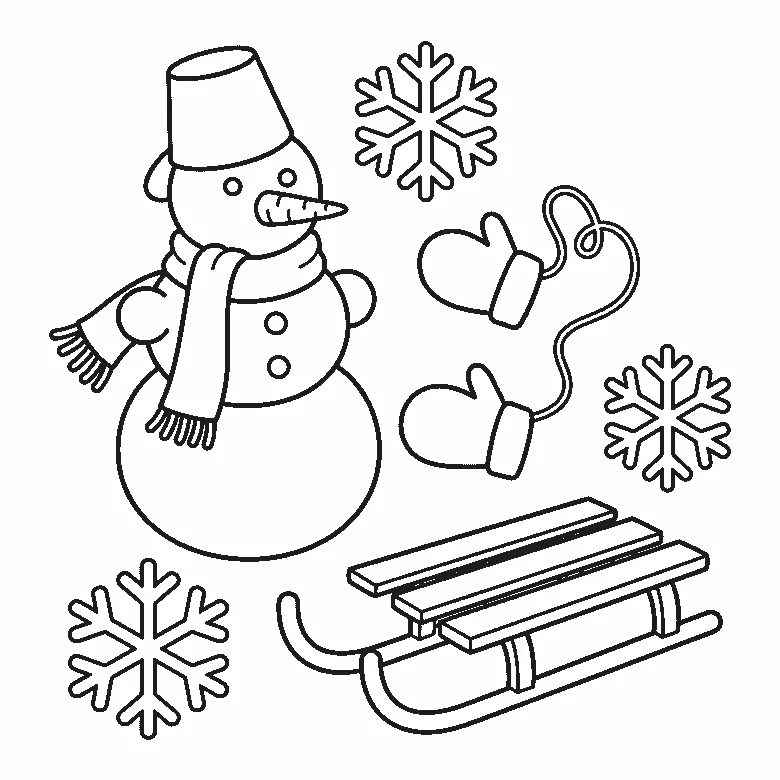
Winter coloring page
A snowman in a bucket hat and fringed scarf, mittens on a cord, three snowflakes and a wooden sled.
Coloring outline drawn by us.
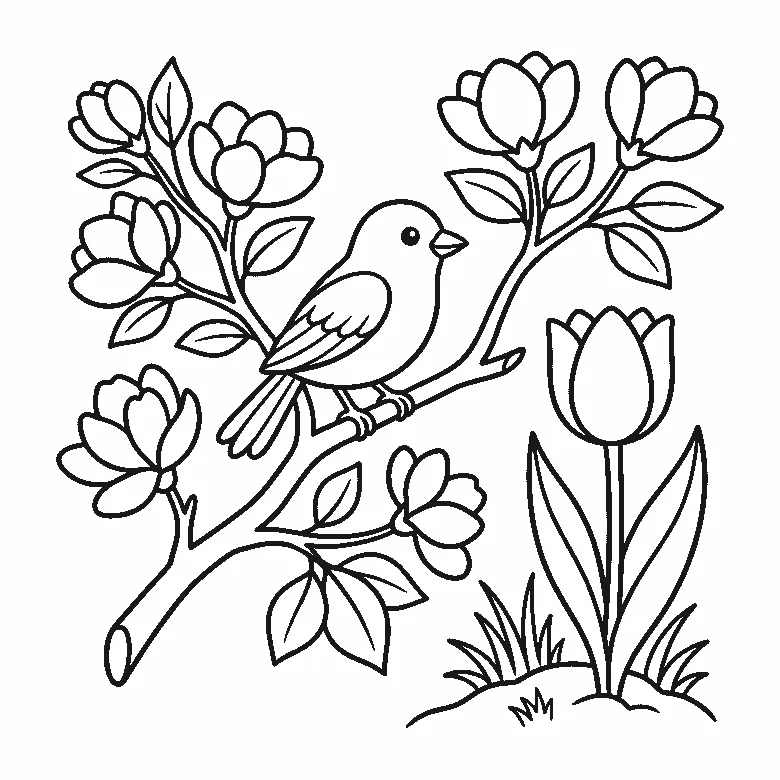
Spring coloring page
A blossom branch with a small bird perched on it, and a tulip rising from a tuft of grass, in black outline.
Coloring outline drawn by us.
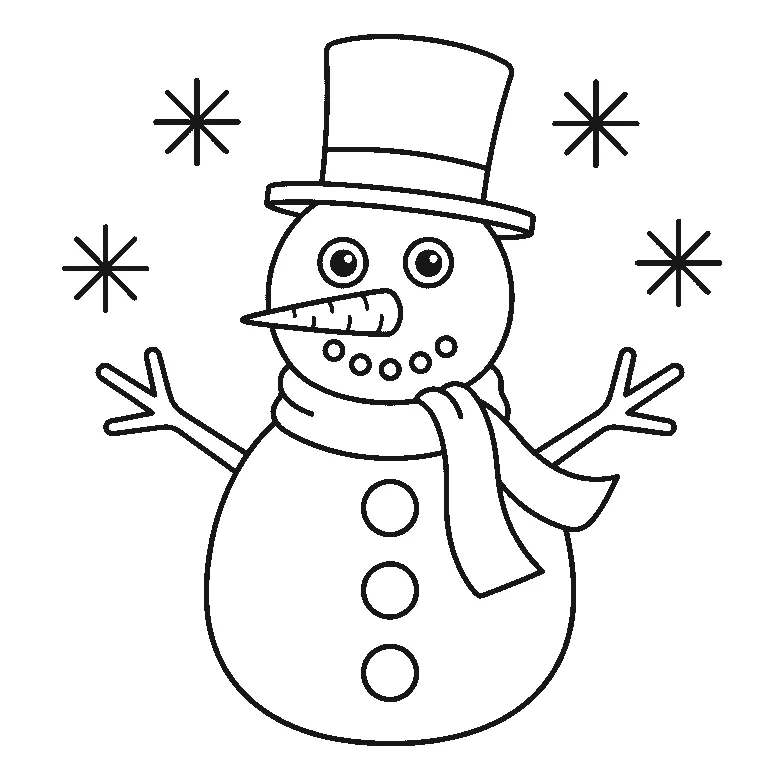
Snowman coloring page
A two-ball snowman in a top hat and scarf, with twig arms and four snowflakes, on one letter-size sheet.
Coloring outline drawn by us.
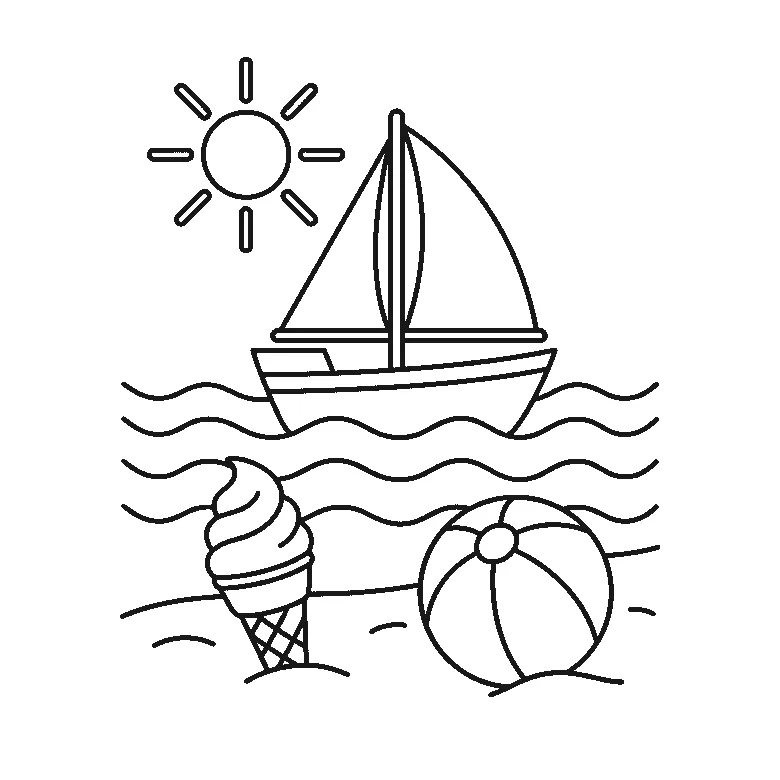
Summer coloring page
A sun, a two-sail boat on waves, an ice cream cone and a paneled beach ball, drawn as one open outline scene.
Coloring outline drawn by us.


