
PDF · US Letter · 15 KB · Free, no sign-up. For home and classroom use.
Heart mandala coloring page
One heart on a starburst at the center, ringed by two rows of larger hearts pointing inward. Free letter-size PDF.
Begin at the middle and the rest of this heart mandala explains itself. A single small heart sits at the center, resting on a starburst whose narrow rays fan out from behind it in every direction. Around that come two rows of larger hearts, and both rows point inward, tips aimed back at the center like spokes. The outer row runs closest to the rim of the circle, and each of its hearts encloses a plain open area inside its outline. Everything is drawn in black outline on white, with no shading, no texture marks, and no fill of any kind.
The starburst is the trickiest part and it is worth doing before your hand gets tired. Its rays are long and thin and they run right up against the center heart, so a fine point matters more there than anywhere else. Two approaches both work. Color every ray the same shade and the burst reads as a solid halo. Alternate two shades ray by ray and it reads as spinning. What does not work well is heavy crayon: the rays are narrow enough that a broad tip will bridge across them and turn the burst into a blot before you have gone a quarter of the way around.
After the burst, the two rings of hearts are pure open sailing. These are the large, simple, forgiving areas of the sheet, each one a single closed shape with a smooth outline and no interior detail at all. You can fill a whole heart flat, or lay a pale base down and press harder near the point so the color deepens toward the tip, which gives each heart a small sense of volume. Because the hearts point inward, deepening the tips pulls the eye toward the center; deepening the round lobes instead pushes it out to the rim.
A heart shape is symmetrical down its vertical axis, which is why folding one in half is the old way to cut a matching pair from paper. That symmetry is doing quiet work here. Each heart in the two rows is tilted so its axis runs along a line through the center of the circle, so the whole mandala is symmetrical too, and any mistake you make on one side is visible against its twin on the other. That sounds like a hazard, and sometimes it is, but it also means you can plan a scheme on one half and simply repeat it around.
Red and pink are the obvious range, and the sheet takes them well, especially if you let the two rows differ so the rings stay distinct. There is no reason to stop there. Hearts colored in greens and blues look like leaves or scales and change the mandala from a valentine into a pattern. A single color used at three different pressures, dark at the rim and palest at the center, turns the whole circle into a gradient. Leaving the outer row white and coloring only the inner ring makes the finished page look like a stamp on an envelope.
Colored pencils are the natural fit because they layer, and layering is what a two-row ring pattern rewards: a base coat over both rows, then a second pass on the outer row alone, gives you two tones from one pencil. Watercolor pencils can be worked dry into the large hearts and then softened with a barely damp brush, though only on thicker paper. Markers are fast and flat and very saturated, which suits the big shapes but not the starburst rays. Crayon skips over the paper grain and leaves a waxy sheen the other media do not.
Send it to the printer on plain letter paper at actual size, not scaled to fit, so the outer row of hearts keeps its full margin. Card stock is worth using if you plan on markers or on any water at all. Two copies printed together let two people color the same design at the same time, and with a symmetrical layout like this one there is an obvious game in it: each person takes a half, using the same colors, and you compare the seam down the middle when both are done.
Apart from the thin rays at the center, the drawing is all curves, one heart shape repeated at two sizes around a circle, which gives the finished page a soft look that suits gift use better than wall use. Cut the circle out and glue it to folded card stock for a handmade card front. Punch a hole above the top of the outer ring and hang it from a thread so it turns. Or trim just the center heart and its burst away from everything else and use that small disc alone, which leaves you a ring of empty hearts you can color a second time.
Before you print
- Do the thin starburst rays first with a sharp point, before your hand tires and the lines get crowded.
- Press harder toward each heart's tip to pull the eye inward, or toward its lobes to push it outward.
- Give the inner and outer rows of hearts different shades so the two rings stay readable from a distance.
- Plan your scheme on one half only, then mirror it, since the layout is symmetrical down the middle.
- Use card stock if you want to soften watercolor pencil in the large hearts without buckling the page.
Published Updated 808 words
More in this section
Star mandala coloring page
Eight-pointed stars and faceted diamonds in rings around a small ringed center, free to print on letter paper.
Coloring outline drawn by us.
Butterfly mandala coloring page
Four rings of butterflies in one circle, drawn as clean black outlines and free to print on letter paper.
Coloring outline drawn by us.
Geometric mandala coloring page
An eight-point star at the center, rings of squares, triangles and pentagons around it, ready to print.
Coloring outline drawn by us.
Abstract mandala coloring page
Teardrop and leaf shapes layered in rings around a small round center, on one free letter-size sheet.
Coloring outline drawn by us.
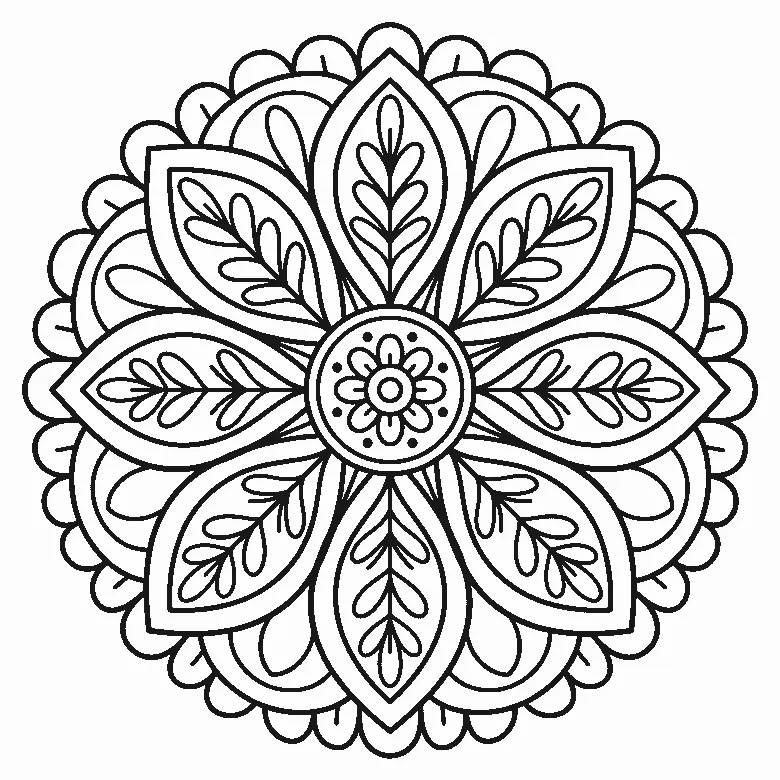
Flower mandala coloring page
Eight petals of leaf sprigs around a ringed center, held inside a scalloped border for slow, quiet coloring.
Coloring outline drawn by us.
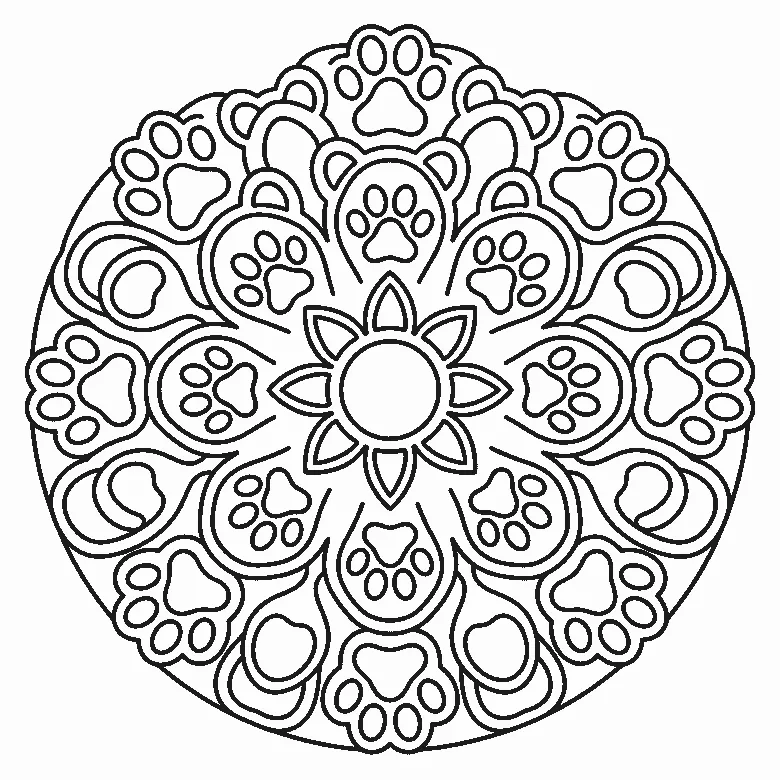
Animal mandala coloring page
A circular mandala of paw prints and rounded ear shapes around an eight-petal flower, free as a letter-size PDF.
Coloring outline drawn by us.


