
PDF · A4 · 12 KB · Free, no sign-up. For home and classroom use.
Snowman colouring page
A two-ball snowman in a top hat and scarf, with twig arms and four snowflakes, on one A4-size sheet.
The snowman on this sheet is built from two stacked snowballs rather than three: a round head and one large body below it, with the scarf wound round the join between them. He faces the viewer. Two round eyes with filled pupils sit high on the head, a long carrot nose crosses the face with ridge lines drawn along it, and a curved row of five small circles makes the mouth below. A tall top hat with a plain band sits on top, three large round buttons run down the front, and a bare twig arm reaches out on each side, each ending in three fingers. Four snowflakes hang in the air around him, each drawn as six straight spokes.
Almost the whole snowman is white in the obvious reading, and that is what makes this sheet unusual to colour: the largest areas are the ones you may want to leave alone. If the two snowballs stay unfilled, everything else has to carry the page, so the hat, the scarf, the nose and the buttons become the whole colour scheme. The alternative is to colour the snow faintly in pale blue or grey and let the white paper show through in patches, which reads as snow far better than a flat fill does.
The scarf is the one long shape on the sheet and the best place for a strong colour. It wraps the neck, crosses at the front and trails off to one side in a long tapering end, so it can carry stripes along its length without any of them being fiddly. Stripes across a scarf are also the easiest pattern to keep even, because the shape narrows steadily and each band can simply follow the width it lands on.
The carrot nose is drawn with ridge lines across it, which is more detail than any other small object here gets. Those ridges make it worth colouring in two passes: a light orange over the whole cone first, then a second pass pressed harder in the gaps between the ridge lines. That is the quickest way to make a flat shape look like something with a surface, and the nose is small enough that it does not take long.
The hat is the second large closed shape and the only place on the page where a very dark colour works without swallowing the drawing. A black crown with a coloured band is the reading the outline invites, and the band is separately outlined so it can differ without any care. The three buttons are the smallest closed shapes on the body and are worth doing before the body around them, so that a wide crayon does not have to steer around three circles.
The four snowflakes are drawn as six straight spokes each, with no closed area at all, so they cannot be filled. They can only be drawn over, which means a coloured pencil or a fine pen tracing along each spoke, or a light wash of colour behind them so that the white paper of the spokes stands out. That second approach is the one that makes them visible from a distance, and it is also the fastest.
Real snowflakes have six arms, which is why the four in the corners are drawn with six spokes rather than five or eight. It comes from the way water molecules lock together as ice forms, and it holds however different two snowflakes look from each other. The twig arms are worth a look too: each ends in three fingers, so there are six small tapering shapes to colour at the ends of the two arms, and they are the narrowest lanes on the sheet.
Print at actual size on plain A4 paper. The five mouth circles and the snowflake spokes are what fit-to-page loses first, and they are also what makes the face read. Heavier paper is worth using if the snowman is going onto a window, because a large white area with colour only around it shows every crease. Cut out along the outer edge, the figure comes away with the hat and the twig arms attached, and the four snowflakes cut out separately into small shapes that can be taped up around him.
Before you print
- Leave the two snowballs white and let the hat, scarf, nose and buttons carry the colour.
- If you do colour the snow, keep it pale and let white paper show through in patches.
- Colour the carrot in two passes, pressing harder only in the gaps between its ridge lines.
- Fill the three buttons before the body around them so a wide crayon has nothing to steer around.
- Wash a light colour behind the snowflakes instead of tracing them; the white spokes then stand out.
Published Updated 707 words
More in this section
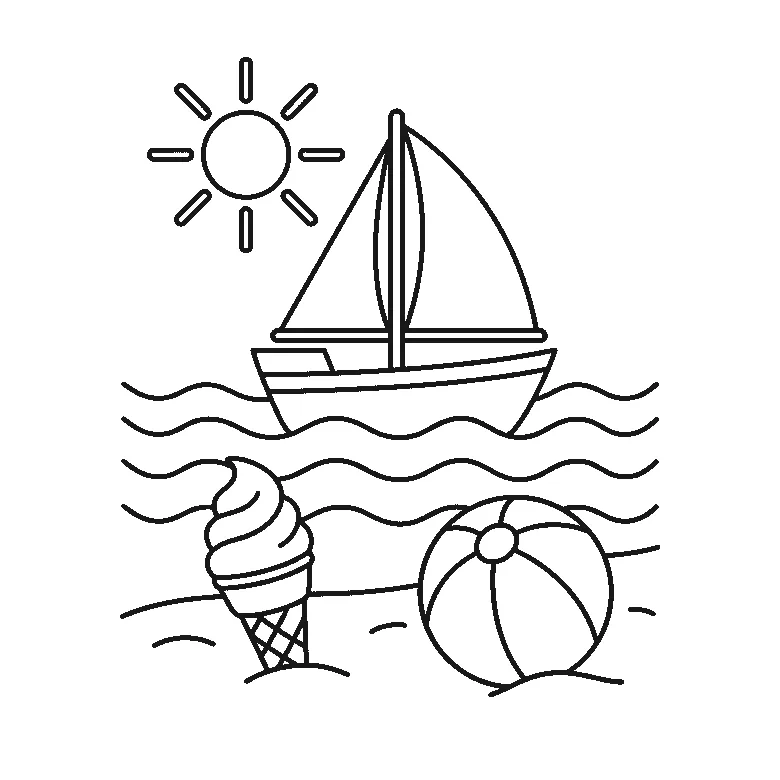
Summer colouring page
A sun, a two-sail boat on waves, an ice cream cone and a paneled beach ball, drawn as one open outline scene.
Colouring outline drawn by us.
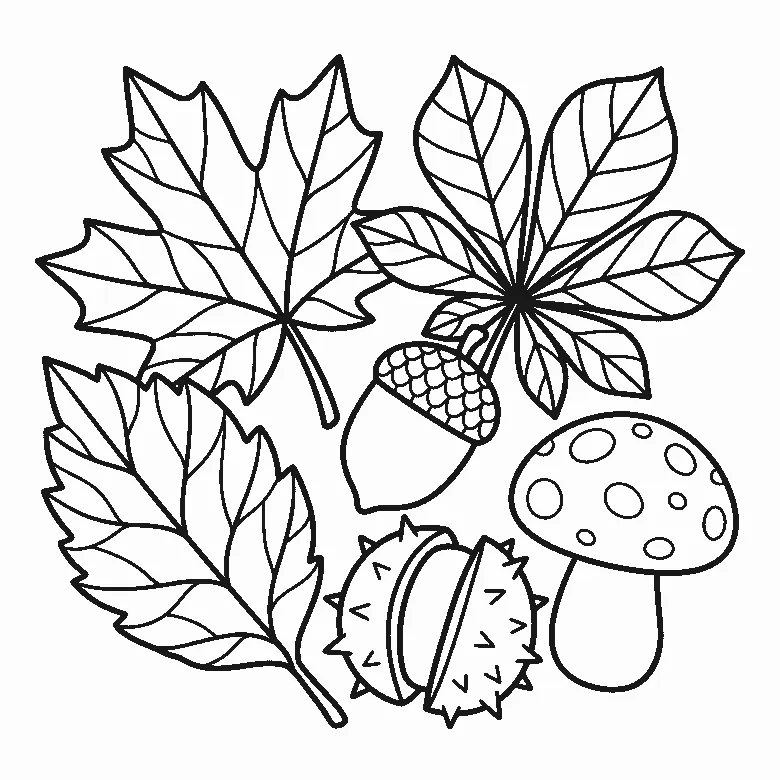
Autumn colouring page
A maple leaf, a chestnut leaf, an acorn, a split spiny case and a spotted mushroom, in plain black outline.
Colouring outline drawn by us.
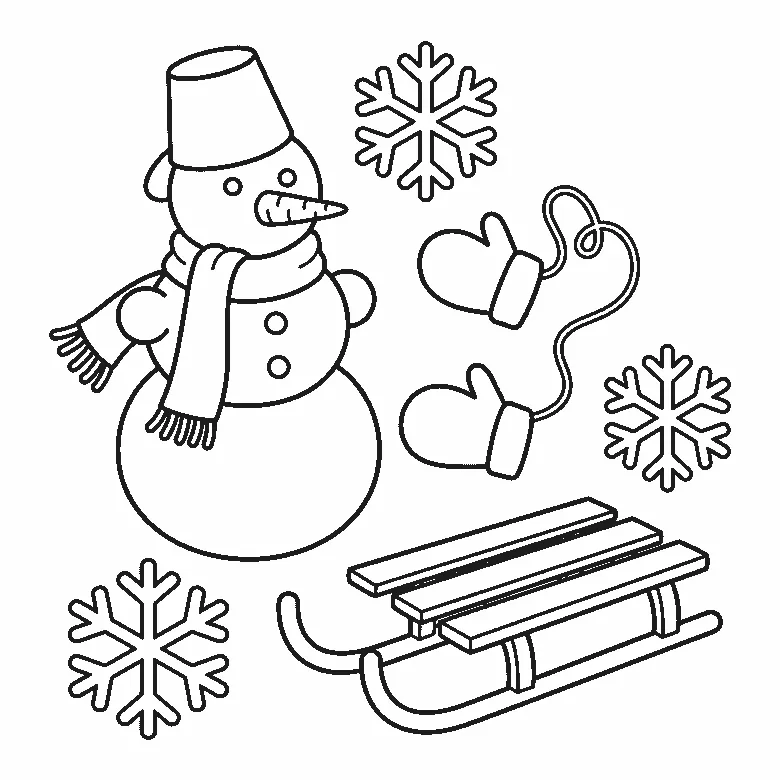
Winter colouring page
A snowman in a bucket hat and fringed scarf, mittens on a cord, three snowflakes and a wooden sledge.
Colouring outline drawn by us.
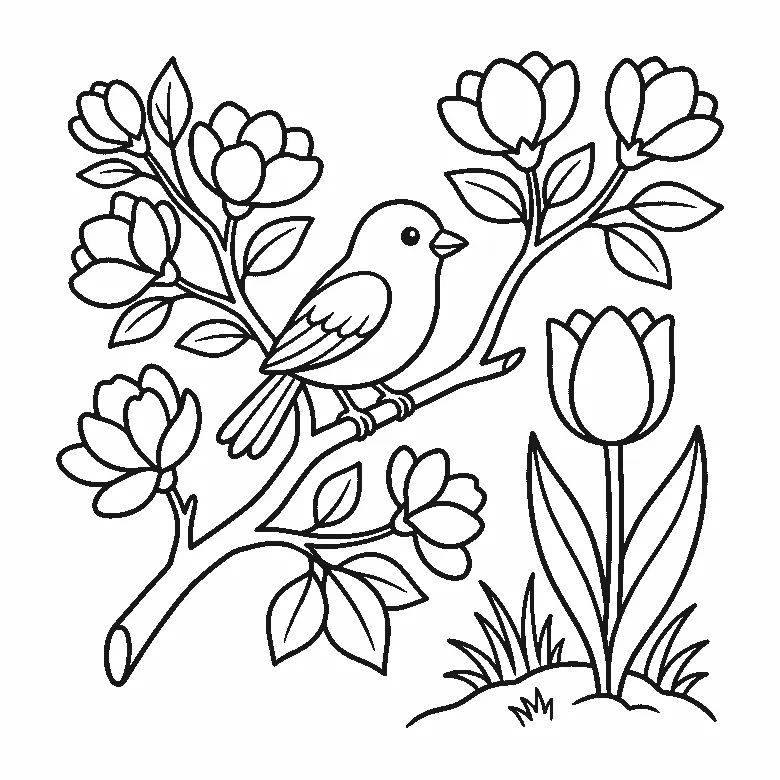
Spring colouring page
A blossom branch with a small bird perched on it, and a tulip rising from a tuft of grass, in black outline.
Colouring outline drawn by us.


